Today's
EarthStation1.com 15% Off Commemorative Memorial Title: Norman
Rockwell: An American Portrait DVD, Video Download, USB Drive
Today, November 14, 2025
November 14: Ruby Bridges Walk To School
Day: -- November 14, 1960: Civil Rights Movements: The American
Civil Rights Movement (1954-1968): School Segregation: School
Segregation In The United States: School Desegregation: School
Desegregation In The United States: The New Orleans School
Desegregation Crisis: -- Ruby Bridges becomes the first African
American child to desegregate the all-white William Frantz
Elementary School in Louisiana during the New Orleans school
desegregation crisis. Ruby Nell Bridges Hall (born September 8,
1954) is as of 2020 an American civil rights activist and chair of
the Ruby Bridges Foundation, which she formed in 1999 to promote
"the values of tolerance, respect, and appreciation of all
differences". She is the subject of a 1964 painting, The
Problem We All Live With by Norman Rockwell, considered an iconic
image of the Civil Rights Movement in the United States. It
depicts the six-year-old Bridges on her way to school. Because of
threats of violence against her, she is escorted by four deputy
U.S. marshals; the painting is framed such that the marshals'
heads are cropped at the shoulders. On the wall behind her is
written the racial slur "nigger" and the letters "KKK";
a smashed and splattered tomato thrown against the wall is also
visible. The white protesters are not visible, as the viewer is
looking at the scene from their point of view. The painting is oil
on canvas and measures 36 inches (91 cm) high by 58 inches (150
cm) wide. The New Orleans School Desegregation Crisis took place
in 1960. Desegregation was a policy that introduced black students
into all-white schools, as ordered by the Supreme Court ruling in
Brown v. Board of Education of Topeka in 1954, in which the Court
ruled racial segregation of public schools to be unconstitutional.
There had been significant backlash from white New Orleans
residents towards desegregating, and the New Orleans school board
tried everything they could to postpone the mandatory
desegregation from the federal government. On November 14, 1960,
two New Orleans elementary schools were desegregated. The two
schools selected to desegregate were the McDonogh 19 Elementary
School and William Frantz Elementary School. Both schools were
located in the Lower Ninth Ward, a predominantly low-income
neighborhood in New Orleans. By the end of the day on November 14,
1960, there were few white children left at McDonogh No. 19 and
William Frantz Elementary schools. A white boycott occurred at
both schools. On the second day of the boycott, a white student
broke the boycott and entered the school when a 34-year-old
Methodist minister, Lloyd Anderson Foreman, walked his 5-year-old
daughter Pam through the angry mob. A few days later, other white
parents began bringing their children. Three 6-year-old girls
Leona Tate, Tessie Prevost and Gail Etienne who became well known
as the McDonogh Three attended the previously all-white school
McDonogh No. 19 and Ruby Bridges attended William Frantz
Elementary School. All four girls faced public humiliation,
taunts, and racial slurs as they walked to school daily. A race
riot broke out on November 16, 1960, in front of the Orleans
Parish school board meeting. There were numerous death threats
against the black children and the presence of United States
Marshals was required for Leona Tate, Ruby Bridges, Tessie Prevost
and Gail Etienne for their attendance at McDonogh No. 19 and
William Frantz Elementary. It took ten more years for the New
Orleans public schools to fully integrate. In September 1962, the
Catholic Schools of Orleans Parish were also integrated. On Sale @
15% Off Discount Till Midnight PT!
https://store.earthstation1.com/norman-rockwell-an-american-portrait-dvd.html
Today's
EarthStation1.com 15% Off Commemorative Memorial Title:
Montparnasse Revisited: The Genius That Was Paris DVD, MP4, USB
Drive
Today, November 14, 2025
November 14, 1840: #BOTD: #HBD! Claude
Monet, French painter, a founder of French Impressionist painting
and the most consistent and prolific practitioner of the
movement's philosophy of expressing one's perceptions before
nature, especially as applied to plein air landscape painting (d.
December 5, 1926) is #born Oscar-Claude Monet on the fifth floor
of 45 rue Laffitte, in the 9th arrondissement of Paris. The term
"Impressionism" is derived from the title of his
painting Impression, soleil levant (Impression, Sunrise), which
was exhibited in 1874 in the first of the independent exhibitions
mounted by Monet and his associates as an alternative to the Salon
de Paris. Monet's ambition of documenting the French countryside
led him to adopt a method of painting the same scene many times in
order to capture the changing of light and the passing of the
seasons. From 1883, Monet lived in Giverny, where he purchased a
house and property and began a vast landscaping project which
included lily ponds that would become the subjects of his
best-known works. He began painting the water lilies in 1899,
first in vertical views with a Japanese bridge as a central
feature and later in the series of large-scale paintings that was
to occupy him continuously for the next 20 years of his life.
Claude Monet died of lung cancer in Giverny, France at the age of
86, and is buried in the Giverny church cemetery. Monet had
insisted that the occasion be simple; thus only about fifty people
attended the ceremony. At his funeral, his long-time friend
Georges Clemenceau removed the black cloth draped over the coffin,
stating, "No black for Monet!" and replaced it with a
flower-patterned cloth. Monet did not leave a will and so his son
Michel inherited his entire estate. Monet's home, garden, and
waterlily pond were bequeathed by Michel to the French Academy of
Fine Arts (part of the Institut de France) in 1966. Through the
Fondation Claude Monet, the house and gardens were opened for
visits in 1980, following restoration.] In addition to souvenirs
of Monet and other objects of his life, the house contains his
collection of Japanese woodcut prints. The house and garden, along
with the Museum of Impressionism, are major attractions in
Giverny, which hosts tourists from all over the world. On Sale @
15% Off Discount Till Midnight PT!
https://store.earthstation1.com/montparnasse-revisted-the-genius-that-was-paris-3-dvd3.html
Today's
EarthStation1.com 15% Off Commemorative Memorial Title: NBC
University Theater Of The Air Literature Radio Series MP3 DVD USB
Today, November 14, 2025
November 14, 1851: First Publications: --
Moby-Dick; Or, The Whale, an epic novel by American writer Herman
Melville, is published in the United States. The book is centered
on the sailor Ishmael's narrative of the maniacal quest of Ahab,
captain of the whaling ship Pequod, for vengeance against Moby
Dick, the giant white sperm whale that bit off his leg on the
ship's previous voyage. A contribution to the literature of the
American Renaissance, Moby-Dick was published to mixed reviews,
was a commercial failure, and was out of print at the time of the
author's death in 1891. Its reputation as a Great American Novel
was established only in the 20th century, after the 1919
centennial of its author's birth. William Faulkner said he wished
he had written the book himself, and D. H. Lawrence called it "one
of the strangest and most wonderful books in the world" and
"the greatest book of the sea ever written". Its opening
sentence, "Call me Ishmael", is among world literature's
most famous. Melville began writing Moby-Dick in February 1850 and
finished 18 months later, a year after he had anticipated.
Melville drew on his experience as a common sailor from 1841 to
1844, including on whalers, and on wide reading in whaling
literature. The white whale is modeled on a notoriously
hard-to-catch albino whale Mocha Dick, and the book's ending is
based on the sinking of the whaleship Essex in 1820. The detailed
and realistic descriptions of whale hunting and of extracting
whale oil, as well as life aboard ship among a culturally diverse
crew, are mixed with exploration of class and social status, good
and evil, and the existence of God. The book's literary influences
include Shakespeare, Thomas Carlyle, Sir Thomas Browne and the
Bible. In addition to narrative prose, Melville uses styles and
literary devices ranging from songs, poetry, and catalogs to
Shakespearean stage directions, soliloquies, and asides. In August
1850, with the manuscript perhaps half finished, he met Nathaniel
Hawthorne and was deeply impressed by his Mosses from an Old
Manse, which he compared to Shakespeare in its cosmic ambitions.
This encounter may have inspired him to revise and deepen
Moby-Dick, which is dedicated to Hawthorne, "in token of my
admiration for his genius". The book was first published (in
three volumes) as The Whale in London in October 1851, and under
its definitive title, Moby-Dick; or, The Whale, in a single-volume
edition in New York in November. The London publisher, Richard
Bentley, censored or changed sensitive passages; Melville made
revisions as well, including a last-minute change of the title for
the New York edition. The whale, however, appears in the text of
both editions as "Moby Dick", without the hyphen.
Reviewers in Britain were largely favorable, though some objected
that the tale seemed to be told by a narrator who perished with
the ship, as the British edition lacked the epilogue recounting
Ishmael's survival. American reviewers were more hostile. On Sale
@ 15% Off Discount Till Midnight PT!
https://store.earthstation1.com/nbc-university-theater-of-the-air-otr-mp3-dv3.html
Today's
EarthStation1.com 15% Off Commemorative Memorial Title: Legacy
With Michael Wood World History TV Series DVD, MP4, USB Stick
Today, November 14, 2025
November 14, 1889: Children's Day
(India): -- #BOTD: #HBD! Jawaharlal Nehru, Indian lawyer and
central figure in Indian politics, Indian independence activist
who emerged as the paramount leader of the Indian independence
movement under the tutelage of Mahatma Gandhi and ruled India from
its establishment as an independent nation in 1947 until his death
in 1964, 1st Prime Minister of India (d. May 27, 1964) is #born in
Allahabad in British India. His birthday is celebrated in India as
Bal Diwas (Children's Day). Pandit (abbrev. Pt.; a Brahmin scholar
or a teacher of any field of knowledge in Hinduism) Jawaharlal
Nehru emerged as an eminent leader of the Indian independence
movement under the tutelage of Mahatma Gandhi and served India as
Prime Minister from its establishment as an independent nation in
1947 until his death in 1964. He has been described the architect
of the modern state of India. He was also known as Pandit Nehru
due to his roots with the Kashmiri Pandit community while Indian
children knew him as Chacha Nehru (Hindi, lit., "Uncle
Nehru"). The son of Motilal Nehru, a prominent lawyer and
nationalist statesman and Swaroop Rani, Nehru was a graduate of
Trinity College, Cambridge and the Inner Temple, where he trained
to be a barrister. Upon his return to India, he enrolled at the
Allahabad High Court and took an interest in national politics,
which eventually replaced his legal practice. A committed
nationalist since his teenage years, he became a rising figure in
Indian politics during the upheavals of the 1910s. He became the
prominent leader of the left-wing factions of the Indian National
Congress during the 1920s, and eventually of the entire Congress,
with the tacit approval of his mentor, Gandhi. As Congress
President in 1929, Nehru called for complete independence from the
British Raj and instigated the Congress's decisive shift towards
the left. Nehru and the Congress dominated Indian politics during
the 1930s as the country moved towards independence. His idea of a
secular nation-state was seemingly validated when the Congress
swept the 1937 provincial elections and formed the government in
several provinces; on the other hand, the separatist Muslim League
fared much poorer. But these achievements were severely
compromised in the aftermath of the Quit India Movement in 1942,
which saw the British effectively crush the Congress as a
political organisation. Nehru, who had reluctantly heeded Gandhi's
call for immediate independence, for he had desired to support the
Allied war effort during World War II, came out of a lengthy
prison term to a much altered political landscape. The Muslim
League under his old Congress colleague and now opponent, Muhammad
Ali Jinnah, had come to dominate Muslim politics in India.
Negotiations between Congress and Muslim League for power sharing
failed and gave way to the independence and bloody partition of
India in 1947. Nehru was elected by the Congress to assume office
as independent India's first Prime Minister, although the question
of leadership had been settled as far back as 1941, when Gandhi
acknowledged Nehru as his political heir and successor. As Prime
Minister, he set out to realise his vision of India. The
Constitution of India was enacted in 1950, after which he embarked
on an ambitious program of economic, social and political reforms.
Chiefly, he oversaw India's transition from a colony to a
republic, while nurturing a plural, multi-party system. In foreign
policy, he took a leading role in the Non-Aligned Movement while
projecting India as a regional hegemon in South Asia. Under
Nehru's leadership, the Congress emerged as a catch-all party,
dominating national and state-level politics and winning
consecutive elections in 1951, 1957, and 1962. He remained popular
with the people of India in spite of political troubles in his
final years and failure of leadership during the 1962 Sino-Indian
War. Pandit Nehru died of a heart attack at 13:44 local time in
New Delhi, India, aged 74. His death was announced in the Lok
Sabha (Hindi: "The House Of The People"), the lower
house of India's bicameral Parliament at 14:00 local time, 16
minutes later, in words similar to Nehru's own at the time of
Gandhi's assassination: "The light is out." India's
future prime minister Atal Bihari Vajpayee famously delivered
Nehru an acclaimed eulogy. He hailed Nehru as Bharat Mata's
"favourite prince" and likened him to the Hindu god
Rama. Draped in the Indian national Tri-colour flag, the body of
Jawaharlal Nehru was placed for public viewing. "Raghupati
Raghava Rajaram" (also called "Ram Dhun"), a bhajan
(devotional song) widely popularised by Mahatma Gandhi and set to
music by Pandit Vishnu Digambar Paluskar, was chanted as the body
was placed on the platform. On May 28, Nehru was cremated in
accordance with Hindu rites at the Shantivan on the banks of the
Yamuna, witnessed by 1.5 million mourners who had flocked into the
streets of Delhi and the cremation grounds. US President Lyndon B.
Johnson remarked on his death "History has already recorded
his monumental contribution to the molding of a strong and
independent India. And yet, it is not just as a leader of India
that he has served humanity. Perhaps more than any other world
leader he has given expression to man's yearning for peace. This
is the issue of our age. In his fearless pursuit of a world free
from war he has served all humanity." Soviet Premier Nikita
Khrushchev remarked "He was a passionate fighter for peace in
the whole world and an ardent champion of the realization of the
principles of peaceful coexistence of states; he was the inspirer
of the policy of Non-Alignment promoted by the Indian Government.
This reasonable policy won India respect and due to it, India is
now occupying a worthy place in the international arena."
Nehru's death left India with no clear political heir to his
leadership. Lal Bahadur Shastri later succeeded Nehru as the prime
minister. In accordance with his final will and testament, Nehru's
ashes were scattered partly in the Ganges and Jumna Rivers, with
most of his ashes scattered "'over the fields where the
peasants of India toil, so they might mingle with the dust and
soil of India and become an indistinguishable part of India".
On Sale @ 15% Off Discount Till Midnight PT!
https://store.earthstation1.com/legacy-with-michael-wood-world-history-tv-series-dvd-mp4-us4.html
Today's
EarthStation1.com 15% Off Commemorative Memorial Title: Remember
When: Page One Print Journalism w/ Dick Cavett DVD, MP4, USB
Today, November 14, 2025
November 14, 1889: Circumnavigation:
Circumnavigation Of The Earth: Nautical Circumnavigation Of The
Earth: The Circumnavigation Of Nellie Bly (Around The World In
Seventy-Two Days): -- Nellie Bly (pen name of Elizabeth Cochran),
born Elizabeth Jane Cochran), American investigative journalist,
industrialist, inventor, and charity worker, sets out from
Hoboken, New Jersey to beat the record of Jules Verne's imaginary
hero Phileas Fogg, who traveled around the world in 80 days.
Nellie Bly returned on January 25th in a time of 72 days, 6 hours
and 11 minutes to Jersey City near Exchange Place at 3:51PM,
setting a new world record, to a tumultuous welcome at Exchange
Place train station. In 1888, Bly suggested to her editor at
Joseph Pulitzer's tabloid newspaper, the New York World. that she
take a trip around the world, attempting to turn the fictional
Around the World in Eighty Days (1873) into fact for the first
time. A year later, at 9:40 a.m. on November 14, 1889, and with
two days' notice, she boarded the Augusta Victoria, a steamer of
the Hamburg America Line,[28] and began her 40,070 kilometer
journey. To sustain interest in the story, the World organized a
"Nellie Bly Guessing Match" in which readers were asked
to estimate Bly's arrival time to the second, with the Grand Prize
consisting at first of a trip to Europe and, later on, spending
money for the trip. During her travels around the world, Bly went
through England, France (where she met Jules Verne in Amiens),
Brindisi, the Suez Canal, Colombo (Ceylon), the Straits
Settlements of Penang and Singapore, Hong Kong, and Japan. Just
over seventy-two days after her departure from Hoboken, Bly was
back in New York. She had circumnavigated the globe, traveling
alone for almost the entire journey. Bly's journey was a world
record, though it only stood for a few months, until entrepreneur,
eccentric and misogynist George Francis Train completed the
journey in 67 days. Around the World in Seventy-Two Days is an
1890 book by Nellie Bly that details her trip. Elizabeth Cochran
Seaman (born Elizabeth Jane Cochran; May 5, 1864 - January 27,
1922), better known by her pen name Nellie Bly, also known for her
expose in which she worked undercover to report on a mental
institution from within, was a pioneer in her field and launched a
new kind of investigative journalism. On Sale @ 15% Off Discount
Till Midnight PT!
https://store.earthstation1.com/remember-when-page-one-dvd-journalism-history-dick-cavett.html
Today's
EarthStation1.com 15% Off Commemorative Memorial Title: Aaron
Copland A Self Portrait DVD, MP4 Video Download, USB Flash Drive
Today, November 14, 2025
November 14, 1900: #BOTD: #HBD! Aaron
Copland, American composer, conductor, composition teacher,
writer, and later a conductor of his own and other American music
(d. December 2, 1990) is #born in Brooklyn, New York, the youngest
of five children in a Conservative Jewish family of Lithuanian
origins. Copland was referred to by his peers and critics as "The
Dean Of American Composers". The open, slowly changing
harmonies in much of his music are typical of what many people
consider to be the sound of American music, evoking the vast
American landscape and pioneer spirit. He is best known for the
works he wrote in the 1930s and 1940s in a deliberately accessible
style often referred to as "populist" and which the
composer labeled his "vernacular" style. Works in this
vein include the ballets Appalachian Spring, Billy The Kid and
Rodeo, his Fanfare for the Common Man and Third Symphony. In
addition to his ballets and orchestral works, he produced music in
many other genres, including chamber music, vocal works, opera and
film scores. After some initial studies with composer Rubin
Goldmark, Copland traveled to Paris, where he first studied with
Isidor Philipp and Paul Vidal, then with noted pedagogue Nadia
Boulanger. He studied three years with Boulanger, whose eclectic
approach to music inspired his own broad taste. Determined upon
his return to the U.S. to make his way as a full-time composer,
Copland gave lecture-recitals, wrote works on commission and did
some teaching and writing. He found composing orchestral music in
the modernist style he had adapted abroad a financially
contradictory approach, particularly in light of the Great
Depression. He shifted in the mid-1930s to a more accessible
musical style which mirrored the German idea of Gebrauchsmusik
("music for use"), music that could serve utilitarian
and artistic purposes. During the Depression years, he traveled
extensively to Europe, Africa, and Mexico, formed an important
friendship with Mexican composer Carlos Chavez and began composing
his signature works. During the late 1940s, Copland became aware
that Stravinsky and other fellow composers had begun to study
Arnold Schoenberg's use of twelve-tone (serial) techniques. After
he had been exposed to the works of French composer Pierre Boulez,
he incorporated serial techniques into his Piano Quartet (1950),
Piano Fantasy (1957), Connotations for orchestra (1961) and
Inscape for orchestra (1967). Unlike Schoenberg, Copland used his
tone rows in much the same fashion as his tonal material-as
sources for melodies and harmonies, rather than as complete
statements in their own right, except for crucial events from a
structural point of view. From the 1960s onward, Copland's
activities turned more from composing to conducting. He became a
frequent guest conductor of orchestras in the U.S. and the UK and
made a series of recordings of his music, primarily for Columbia
Records. Copland's health deteriorated through the 1980s, and he
died of Alzheimer's disease and respiratory failure on December 2,
1990, in North Tarrytown, New York (now Sleepy Hollow), aged 90.
Following his death, his ashes were scattered over the Tanglewood
Music Center near Lenox, Massachusetts. On Sale @ 15% Off Discount
Till Midnight PT!
https://store.earthstation1.com/aaron-copland-a-self-portrait-dvd.html
Today's
EarthStation1.com 15% Off Commemorative Memorial Title: Crime Vs
Uncle Sam: Kefauver & Army-McCarthy Hearings MP4 Download DVD
Today, November 14, 2025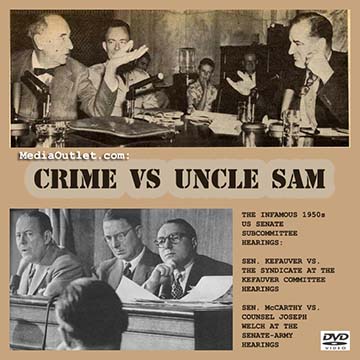
November 14, 1908: #BOTD: Joseph
McCarthy, American captain, lawyer, judge and politician (d. May
2, 1957) is #born Joseph Raymond McCarthy on a farm in Grand
Chute, Wisconsin. He was an American politician who served as U.S.
Senator from the state of Wisconsin from 1947 until his death in
1957. Beginning in 1950, McCarthy became the most visible public
face of a period in the United States in which Cold War tensions
fueled fears of widespread Communist subversion. He is known for
alleging that numerous Communists and Soviet spies and
sympathizers had infiltrated the United States federal government,
universities, film industry, and elsewhere. Ultimately, the smear
tactics he used led him to be censured by the U.S. Senate. The
term "McCarthyism", coined in 1950 in reference to
McCarthy' practices, was soon applied to similar anti-communist
activities. Today, the term is used in reference to what are
considered demagogic, reckless, and unsubstantiated accusations,
as well as public attacks on the character or patriotism of
political opponents. McCarthy was commissioned into the Marine
Corps in 1942, where he served as an intelligence briefing officer
for a dive bomber squadron. Following the end of World War II, he
attained the rank of major. He volunteered to fly twelve combat
missions as a gunner-observer, acquiring the nickname "Tail-Gunner
Joe". Some of his claims of heroism were later shown to be
exaggerated or falsified, leading many of his critics to use
"Tail-Gunner Joe" as a term of mockery. McCarthy
successfully ran for the U.S. Senate in 1946, defeating Robert M.
La Follette Jr. After three largely undistinguished years in the
Senate, McCarthy rose suddenly to national fame in February 1950
when he asserted in a speech that he had a list of "members
of the Communist Party and members of a spy ring" who were
employed in the State Department. In succeeding years after his
1950 speech, McCarthy made additional accusations of Communist
infiltration into the State Department, the administration of
President Harry S. Truman, the Voice Of America, and the U.S.
Army. He also used various charges of communism, communist
sympathies, disloyalty, or sex crimes to attack a number of
politicians and other individuals inside and outside of
government. This included a concurrent "Lavender Scare"
against suspected homosexuals (as homosexuality was prohibited by
law at the time, it was also perceived to increase a person' risk
for blackmail). With the highly publicized Army-McCarthy hearings
of 1954, and following the suicide of Wyoming Senator and McCarthy
enemy Lester C. Hunt that same year, McCarthy' support and
popularity faded. On December 2, 1954, the Senate voted to censure
Senator McCarthy by a vote of 67-22, making him one of the few
senators ever to be disciplined in this fashion. McCarthy died at
Bethesda Naval Hospital in Bethesda, Maryland on May 2, 1957, at
the age of 48. His death certificate listed the cause of death as
"Hepatitis, acute, cause unknown". Doctors had not
previously reported him to be in critical condition. Some
biographers say this was caused or exacerbated by alcoholism. He
is buried at Saint Mary's Cemetery in Appleton, Wisconsin. On Sale
@ 15% Off Discount Till Midnight PT!
https://store.earthstation1.com/crime-vs-uncle-sam-kefauver-syndicate-mccarthy-army-hearings-dvd.html
Today's
EarthStation1.com 15% Off Commemorative Memorial Title: Brute
Force: Aircraft Carriers George C. Scott DVD MP4 Video Download
Today, November 14, 2025
November 14, 1910: Aviation: The History
Of Aviation: The History Of Military Aviation: Naval Aviation: The
History Of Naval Aviation: Aviation In The Pioneer Era: Military
Aviation In The Pioneer Era: The History Of Military Aviation In
The Pioneer Era: Naval Aviation: The History Of Naval Aviation:
The History Of Naval Aviation In The Pioneer Era: -- Aviation
pioneer Eugene Burton Ely performs the first takeoff from a ship
in Hampton Roads, Virginia when he takes off from a makeshift deck
on the USS Birmingham in a Curtiss pusher. That October, Ely and
Glenn Curtiss, American aviation and motorcycling pioneer who was
a founder of the U.S. aircraft industry, met Captain Washington
Chambers, USN, who had been appointed by George Von Lengerke
Meyer, the Secretary of the Navy, to investigate military uses for
aviation within the Navy. This led to two experiments. On November
14, 1910, Ely took off in a Curtiss Pusher from a temporary
platform erected over the bow of the light cruiser USS Birmingham.
The airplane plunged downward as soon as it cleared the 83-foot
platform runway; and the aircraft wheels dipped into the water
before rising. Ely's goggles were covered with spray, and the
aviator promptly landed on a beach rather than circling the harbor
and landing at the Norfolk Navy Yard as planned. John Barry Ryan,
head of the U.S. Aeronautical Reserve, offered 500 USD to build
the platform, and a 500 USD prize, for a ship to shore flight. Two
months later, on January 18, 1911, Ely landed his Curtiss Pusher
airplane on a platform on the armored cruiser USS Pennsylvania
anchored in San Francisco Bay. Ely flew from the Tanforan
Racetrack in San Bruno, California and landed on the Pennsylvania,
which was the first successful shipboard landing of an aircraft.
This flight was also the first ever using a tailhook system,
designed and built by circus performer and aviator Hugh Robinson.
Ely told a reporter: "It was easy enough. I think the trick
could be successfully turned nine times out of ten." USS
Birmingham (CS-2/CL-2), named for the city of Birmingham, Alabama,
was a Chester-class scout cruiser, reclassified a light cruiser in
1920. Entering service in 1908, the ship became known for the
first airplane takeoff from a ship in history in 1910. During
World War I, Birmingham escorted convoys across the Atlantic. The
cruiser was decommissioned in 1923 and sold for scrap in 1930. On
Sale @ 15% Off Discount Till Midnight PT!
https://store.earthstation1.com/brute-force-aircraft-carriers-george-c-scott-dvd-mp4-video-downloa4.html
Today's
EarthStation1.com 15% Off Commemorative Memorial Title: BBC
Engineering Society Early Days Of Broadcasting CD MP3 Download USB
Today, November 14, 2025
November 14, 1922: Broadcasting: The
History Of Broadcasting: Radio: The History Of Radio Broadcasting:
-- The British Broadcasting Company begins radio service in the
United Kingdom when 2LO, the second radio station to regularly
broadcast in the United Kingdom (the first was 2MT) is transferred
to the new British Broadcasting Company. In 1923 the British
Broadcasting Company took to nearby Savoy Hill for its
broadcasting studios. In 1927 the company became the British
Broadcasting Corporation. On March 9, 1930 2LO was replaced by the
BBC Regional Programme and the BBC National Programme. The letters
LO continued to be used internally as a designation in the BBC for
technical operations in the London area (for example, the
numbering of all recordings made in London contained LO). The code
LO was changed to LN in the early 1970s. The 2LO transmitter now
belongs to the Science Museum, having been donated by Crown Castle
International on November 7 2002. It is now on show in the
Information Age gallery on the second floor of the museum. The
British Broadcasting Company, Ltd. (BBC) was a British commercial
company formed on October 18, 1922 by British and American
electrical companies doing business in the United Kingdom.
Licensed by the British General Post Office, their original office
was located on the second floor of Magnet House, the GEC buildings
in London and consisted of a room and a small antechamber. On
December 14, 1922, John Reith was hired to become the Managing
Director of the company at that address. The company later moved
its offices to the premises of the Marconi Company. The BBC as a
commercial broadcasting company did not sell air time but it did
carry a number of sponsored programmes paid for by British
newspapers. On December 31 1926, the company was dissolved, and
its assets were transferred to the non-commercial and
crown-chartered British Broadcasting Corporation (BBC). On Sale @
15% Off Discount Till Midnight PT!
https://store.earthstation1.com/bbc-engineering-society-the-early-days-of-broadcasting-mp3-c3.html
Today's
EarthStation1.com 15% Off Commemorative Memorial Title: The Secret
War Historic WWII TV Series + Bonus Title DVD MP4 USB Drive
Today, November 14, 2025
November 14-15, 1940: The European Civil
War: World War II: The Second European War (The European Theater
Of World War II): Aviation: Military Aviation: Air Warfare Of
World War II: The Battle of Britain: Strategic Bombing During
World War II: European Air Operations During The Battle Of Europe:
The Blitz: The Coventry Blitz (The Coventration): -- The city of
Coventry, England is heavily bombed by 515 German Luftwaffe
bombers from Luftflotte 3 and from the pathfinders of Kampfgruppe
100 during the overnight of November 14-15. Coventry Cathedral is
almost completely destroyed. The Coventry Blitz (blitz: from the
German word Blitzkrieg meaning "lightning war") was a
series of bombing raids that took place on the English city of
Coventry. The city was bombed many times during the Second World
War by the German Air Force (Luftwaffe). The most devastating of
these attacks occurred on the evening of November 14, 1940 and
continued into the morning of November 15. In one night, more than
4,300 homes in Coventry were destroyed and around two-thirds of
the city's buildings were damaged. The raid was heavily
concentrated on the city centre, most of which was destroyed. Two
hospitals, two churches and a police station were also damaged.
The local police force lost no fewer than nine constables or
messengers in the blitz. Approximately one third of the city's
factories were completely destroyed or severely damaged, another
third were badly damaged, and the rest suffered slight damage.
Among the destroyed factories were the main Daimler factory, the
Humber Hillman factory, the Alfred Herbert Ltd machine tool works,
nine aircraft factories, and two naval ordnance stores. However,
the effects on war production were only temporary, as much
essential war production had already been moved to 'shadow
factories' on the city outskirts. Also, many of the damaged
factories were quickly repaired and had recovered to full
production within a few months. An estimated 568 people were
killed in the raid (the exact figure was never precisely
confirmed), with another 863 badly injured and 393 sustaining
lesser injuries. Given the intensity of the raid, casualties were
limited by the fact that a large number of Coventrians "trekked"
out of the city at night to sleep in nearby towns or villages
following the earlier air raids. Also, people who took to air raid
shelters suffered very little death or injury. Out of 79 public
air raid shelters holding 33,000 people, very few had been
destroyed. The attack, code-named Operation Mondscheinsonate
(German: Operation Moonlight Sonata), inflicted considerable
damage to monuments and residential areas. The initial wave of 13
specially modified Heinkel He 111 aircraft of Kampfgruppe 100,
which were equipped with X-Gerat (German: X-Device) navigational
devices, accurately dropped navigational marker flares at 19:20.
The British and the Germans were fighting the Battle of the Beams
and on this night the British failed to disrupt the X-Gerat
signals. The Battle of the Beams was a period early in the Second
World War when bombers of the German Air Force (Luftwaffe) used a
number of increasingly accurate systems of radio navigation for
night bombing in the United Kingdom. British scientific
intelligence at the Air Ministry fought back with a variety of
their own increasingly effective means, involving jamming and
distortion of the radio waves. The period ended when the Wehrmacht
moved their forces to the East in May 1941, in preparation for the
attack on the Soviet Union. The first wave of follow-up bombers
dropped high explosive bombs, knocking out the utilities (the
water supply, electricity network, telephones and gas mains) and
cratering the roads, making it difficult for the fire engines to
reach fires started by the later waves of bombers. These later
waves dropped a combination of high explosive and incendiary
bombs. There were two types of incendiary bomb: Those made of
magnesium and those made of petroleum. The high explosive bombs
and the larger air-mines not only hindered the Coventry fire
brigade, they were also intended to damage roofs, making it easier
for the incendiary bombs to fall into buildings and ignite them.
Coventry's air defences consisted of twenty-four 3.7 inch AA guns
and twelve 40 mm Bofors. The AA Defence Commander of 95th
(Birmingham) Heavy Anti-Aircraft Regiment, Royal Artillery, had
prepared a series of concentrations to be fired using
sound-locators and GL Mk. I gun-laying radar, and 128
concentrations were fired before the bombing severed all lines of
communication and the noise drowned out sound-location. The
anti-aircraft batteries then fought on in isolation. Some gun
positions were able to fire at searchlight beam intersections,
glimpsed through the smoke and guessing the range. Although the
Coventry guns fired 10 rounds a minute for the whole 10 hour raid
(a total of over 6,700 rounds), only one German bomber was shot
down. At around 20:00, Coventry Cathedral (dedicated to Saint
Michael), was set on fire by incendiaries for the first time. The
volunteer firefighters managed to put out the first fire but other
direct hits followed and soon new fires broke out in the
cathedral; accelerated by a firestorm, the flames quickly spread
out of control. During the same period, more than 200 other fires
were started across the city, most of which were concentrated in
the city-centre area, setting the area ablaze and overwhelming the
firefighters. The telephone network was crippled, hampering the
fire service's command and control and making it difficult to send
firefighters to the most dangerous blazes first; as the Germans
had intended, the water mains were damaged by high explosives,
meaning there was not enough water available to tackle many of the
fires. The raid reached its climax around midnight with the final
all clear sounding at 06:15 on the morning of November 15.
Although the city centre suffered the heaviest raids, districts of
the city including Stoke Heath, Foleshill and Wyken were also
heavily bombed. The raid reached such a new and severe level of
destruction that Joseph Goebbels later used the term coventriert
("coventried") when describing similar levels of
destruction of other enemy towns. During the raid, the Germans
dropped about 500 tonnes of high explosives, including 50
parachute air-mines, of which 20 were incendiary petroleum mines,
and 36,000 incendiary bombs. The raid of November 14, combined
several innovations which influenced all future strategic bomber
raids during the war. These were: 1) The use of pathfinder
aircraft with electronic aids to navigate, to mark the targets
before the main bomber raid; and 2) The use of high explosive
bombs and air-mines (blockbuster bombs) coupled with thousands of
incendiary bombs intended to set the city ablaze in a firestorm.
In the Allied raids later in the war, 500 or more heavy
four-engine bombers all delivered their 3,000-6,000-pound
(1,400-2,700 kg) bomb loads in a concentrated wave lasting only a
few minutes. But at Coventry, the German twin-engined bombers
carried smaller bomb loads (2,000-4,000 pounds (910-1,810 kg)),
and attacked in smaller multiple waves. Each bomber flew several
sorties over the target, returning to base in France to rearm.
Thus the attack was spread over several hours, and there were
lulls in the raid when firefighters and rescuers could reorganise
and evacuate civilians. As Arthur Harris, commander of RAF Bomber
Command, wrote after the war: "Coventry was adequately
concentrated in point of space [to start a firestorm], but all the
same there was little concentration in point of time." The
British used the opportunity given them by the attack on Coventry
to try a new tactic against Germany, which was carried out on
December 16, 1940 as part of Operation Abigail Rachel against
Mannheim. The British had been waiting for the opportunity to
experiment with an incendiary-intensive raid, considering it a
kind of retaliation for the German raid on Coventry. This was the
start of a British drift away from precision attacks on military
targets and towards area bombing attacks on whole cities. On Sale
@ 15% Off Discount Till Midnight PT!
https://store.earthstation1.com/the-secret-war-wwii-weaponry-tv-series-all-7-episodes-2-dv72.html
Today's
EarthStation1.com 15% Off Commemorative Memorial Title: Crime
Inc.: The True Story Of The Mafia TV Series DVD, MP4, USB Stick
Today, November 14, 2025
November 14, 1957: Crime: Organized
Crime: Organized Crime In The United States: The American Mafia
(The Italian-American Mafia, The Mafia, The Mob): Mafia Summit
Meetings: The Apalachin Meeting: -- In rural Tioga County in
upstate New York, a historic summit of the American Mafia held at
the home of mobster Joseph "Joe the Barber" Barbara, at
625 McFall Road in Apalachin, New York is raided by law
enforcement; many high level Mafia figures are arrested while
trying to flee. The Apalachin Meeting was allegedly held to
discuss various topics including loansharking, narcotics
trafficking, and gambling, along with dividing the illegal
operations controlled by the recently murdered Albert Anastasia.
An estimated 100 Mafiosi from the United States, Italy, and Cuba
are thought to have attended this meeting. Immediately after the
Anastasia murder that October, and after taking control of the
Luciano crime family, renamed the Genovese crime family, away from
Frank Costello, Vito Genovese wanted to legitimize his new power
by holding a national Cosa Nostra meeting. Local and state law
enforcement became suspicious when numerous expensive cars bearing
license plates from around the country arrived in what was
described as "the sleepy hamlet of Apalachin". After
setting up roadblocks, the police raided the meeting, causing many
of the participants to flee into the woods and area surrounding
the Barbara estate. More than 60 underworld bosses were detained
and indicted following the raid. Twenty of those who attended the
meeting were charged with "Conspiring to obstruct justice by
lying about the nature of the underworld meeting" and found
guilty in January 1959. All were fined, up to 10K USD each, and
given prison sentences ranging from three to five years. All the
convictions were overturned on appeal the following year. One of
the most direct and significant outcomes of the Apalachin Meeting
was that it helped to confirm the existence of a nationwide
criminal conspiracy, a fact that some, including Federal Bureau of
Investigation Director J. Edgar Hoover, had long refused to
acknowledge. The Apalachin Meeting is investigated in detail in
the 1984 TV documentary series Crime Inc. On Sale @ 15% Off
Discount Till Midnight PT!
https://store.earthstation1.com/crime-inc-the-true-story-of-the-mafia-dvd-set-2-disc2.html
Today's
EarthStation1.com 15% Off Commemorative Memorial Title: Chopper
Wars: Airmobile Helicopters & The Vietnam War DVD, MP4, USB
Today, November 14, 2025
NNovember 14, 1965: The Aftermath Of
World War II: The Cold War: The Cold War In Asia: The Indochina
Wars: The Vietnam War (The Second Indochina War, The Vietnam
Conflict, The Resistance War Against America): The United States
In The Vietnam War: :Operation Silver Bayonet I: The Pleiku
Campaign 1965): The Battle Of Ia Drang: -- The first major battle
between the United States Army and The People's Army Of Vietnam
(PAVN), also referred to as the North Vietnamese Army (NVA),
begins. It is notable for being the first large scale helicopter
air assault and also the first use of Boeing B-52 Stratofortress
strategic bombers in a tactical bombing support role. It was part
of the Pleiku Campaign conducted early in the Vietnam War. It
comprised two main engagements, centered on two previously scouted
helicopter landing zones (LZs), known as LZ X-Ray and LZ Albany.
The first involved the 1st Battalion, 7th Cavalry Regiment and
supporting units under the command of Lieutenant Colonel Hal
Moore, and took place November 14-16, 1965 at LZ X-Ray, located at
the eastern foot of the Chu Pong Massif in the central highlands
of Vietnam. The second engagement involved the 2nd Battalion, 7th
Cavalry Regiment plus supporting units under the command of
Lieutenant Colonel Robert McDade, and took place on November 17 at
LZ Albany, farther north in the Ia Drang Valley. Surrounded and
under heavy fire from a numerically superior force, the American
forces at LZ X-ray were able to hold off and drive back the North
Vietnamese forces over three days of battle, largely through the
support of both air power and heavy artillery bombardment, which
the North Vietnamese lacked. LZ X-Ray was considered an American
tactical victory, as the Americans claimed an almost 10:1 kill
ratio. At LZ Albany, however, an American battalion was ambushed
in close quarters. They were unable to use air and artillery
support due to the close engagement of the North Vietnamese, and
the Americans suffered an over-50% casualty rate before being
extricated from the battle. Both sides, therefore, were able to
claim victory in the battle. The size of the clearing at LZ X-Ray
meant that troops had to be shuttled in, the first lift landing at
10:48. The last troops of the battalion were landed at 15:20, by
which time the troops on the ground were already heavily engaged,
with one platoon cut off. Faced with heavy casualties and
unexpected opposition, 1st Battalion was reinforced by B Company
2nd Battalion 7th Cavalry. Fighting continued the following day
when the LZ was further reinforced by A Company 2/7 and also by
2nd Battalion 5th Cavalry, and the lost platoon was rescued. The
last Vietnamese assaults on the position were repulsed on the
morning of the 16th. As the Vietnamese forces melted away, the
remainder of 2/7 and A Company of 1st Battalion 5th Cavalry
arrived. By mid-afternoon 1/7 and B Company 2/7 had been airlifted
to LZ Falcon, and on the 17th of November 2/5 marched out towards
LZ Columbus while the remaining 2/7 and 1/5 companies marched
towards LZ Albany. The latter force became strung out and, in the
early afternoon, were badly mauled in an ambush before they could
be reinforced and extricated. The battle at LZ X-Ray was
documented in the CBS special report Battle of Ia Drang Valley by
Morley Safer and the critically acclaimed book We Were Soldiers
Once... And Young by Harold G. Moore and Joseph L. Galloway. In
1994, Moore, Galloway and men who fought on both the American and
North Vietnamese sides, traveled back to the remote jungle
clearings where the battle took place. At the time the U.S. did
not have diplomatic relations with Vietnam. The risky trip which
took a year to arrange was part of an award-winning ABC News
documentary, They Were Young and Brave produced by Terence Wrong.
Randall Wallace depicted the battle at LZ X-Ray in the 2002 movie
We Were Soldiers starring Mel Gibson and Barry Pepper as Moore and
Galloway, respectively. Galloway later described Ia Drang as "the
battle that convinced Ho Chi Minh he could win". On Sale @
15% Off Discount Till Midnight PT!
https://store.earthstation1.com/chopper-wars-vietnam-war-amp-airmobile-helicopters-dvd-mp4-us4.html
Today's
EarthStation1.com 15% Off Commemorative Memorial Title: Outer
Space Films 9: Mars Probes DVD, Video Download, USB Flash Drive
Today, November 14, 2025
November 14, 1971: The History Of
Rocketry: The History Of Spaceflight: The Aftermath Of World War
II: The Cold War: The Space Age: The Space Race: The Discovery And
Exploration Of The Solar System: Space Probes: Interplanetary
Space Probes: The Mariner Program: Mariner 9 (Mariner Mars '71 /
Mariner-I) -- Mariner 9 becomes the first spacecraft to orbit
another planet when it enters orbit around Mars, only narrowly
beating the Soviet's Mars 2 and Mars 3, which both arrived within
a month.. Mariner 9 was an unmanned NASA space probe that
contributed greatly to the exploration of Mars and was part of the
Mariner program. It was launched toward Mars on May 30, 1971 from
Cape Canaveral Air Force Station and reached the planet on
November 14, of the same year. After months of dust storms it
managed to send back clear pictures of the surface. Mariner 9
returned 7329 images over the course of its mission, which
concluded in October 1972. On Sale @ 15% Off Discount Till
Midnight PT!
https://store.earthstation1.com/outer-space-films-9-mars-space-probe-projects-viking-amp-mariner-dv9.html
Today's
EarthStation1.com #OnThisDay Commemorative Memorial Title: TV From
The Crumbling Eastern Bloc DVD MP4 Video Download
Today, November 14, 2025 November 14: National Pickle Day: -- An
annual recognition of the tart, sometimes sweet, and even spicy
pickle! Each year on November 14th, pickle lovers pop open pecks
of their preferred preserved pickle. It may be a Dill, Gherkin,
Cornichon, Brined, Kosher Dill, Polish, Hungarian, Lime, Bread and
Butter, Swedish and Danish, or Kool-Aid Pickle. No matter your
choice, eat them all day long. The term pickle comes from the
Dutch word pekel, meaning brine. In the United States, the word
pickle typically refers to a pickled cucumber. However, just about
any fruit or vegetable can be pickled. The process typically
starts with a blanching process, depending on the fruit or
vegetable. Then the product is packed into jars with seasonings
that will give the pickles their flavor. They can be spicy, tart,
or sweet. However, the tartness and sweetness come from the brine.
A basic brine includes vinegar and water. Various amounts of sugar
adjust the level of sweetness in the brine. We consume a
phenomenal 5,200,000 pounds of pickles each year in the United
States. While pickles can be high in sodium, they are a good
source of vitamin K. In moderation, they make a great snack. Food
vendors sometimes serve pickles on a stick at fairs or carnivals.
They are known as stick pickles. A rising trend in the United
States is deep-fried pickles. The pickle is wrapped in dough or
dipped in breading and deep-fried. The popularity of the pickle
dates back thousands of years to 2030 B.C. At that time, traders
imported cucumbers from India to the Tigris Valley. Here the
people first preserved and ate the cucumbers as pickles. Cleopatra
attributed her good looks to her diet of pickles. Even Julius
Caesar craved the benefits of pickles. He believed pickles lent
physical and spiritual strength and gave them to his troops. Snack
on a pickle to celebrate, but don't stop there. This snack is
multipurpose. They make delicious additions to salads and
sandwiches. Grind them up and make a relish. Experimenting with
pizza? Top it with some pickles. If your Sloppy Joe is missing a
little zing, add some pickles. While not everything is better with
pickles (ice cream?), a little experimentation goes a long way
with pickles. To observe National Pickle Day, try tasting pickled
carrots, cauliflower, or watermelon. Even some proteins are
pickled, such as eggs. What's your favorite kind of pickle? Sweet,
spicy, dill? Let us know by using #NationalPickleDay and posting
on social media! While this holiday has been celebrated for 70
years on various days, the originator of National Pickle Day;
however, in 1949, the first observance began with encouragement
from the Pickle Packers Association.
https://store.earthstation1.com/tv-from-the-crumbling-eastern-bloc-dvd-mp4-video-downloa4.html
November 14: National Pickle Day: -- An
annual recognition of the tart, sometimes sweet, and even spicy
pickle! Each year on November 14th, pickle lovers pop open pecks
of their preferred preserved pickle. It may be a Dill, Gherkin,
Cornichon, Brined, Kosher Dill, Polish, Hungarian, Lime, Bread and
Butter, Swedish and Danish, or Kool-Aid Pickle. No matter your
choice, eat them all day long. The term pickle comes from the
Dutch word pekel, meaning brine. In the United States, the word
pickle typically refers to a pickled cucumber. However, just about
any fruit or vegetable can be pickled. The process typically
starts with a blanching process, depending on the fruit or
vegetable. Then the product is packed into jars with seasonings
that will give the pickles their flavor. They can be spicy, tart,
or sweet. However, the tartness and sweetness come from the brine.
A basic brine includes vinegar and water. Various amounts of sugar
adjust the level of sweetness in the brine. We consume a
phenomenal 5,200,000 pounds of pickles each year in the United
States. While pickles can be high in sodium, they are a good
source of vitamin K. In moderation, they make a great snack. Food
vendors sometimes serve pickles on a stick at fairs or carnivals.
They are known as stick pickles. A rising trend in the United
States is deep-fried pickles. The pickle is wrapped in dough or
dipped in breading and deep-fried. The popularity of the pickle
dates back thousands of years to 2030 B.C. At that time, traders
imported cucumbers from India to the Tigris Valley. Here the
people first preserved and ate the cucumbers as pickles. Cleopatra
attributed her good looks to her diet of pickles. Even Julius
Caesar craved the benefits of pickles. He believed pickles lent
physical and spiritual strength and gave them to his troops. Snack
on a pickle to celebrate, but don't stop there. This snack is
multipurpose. They make delicious additions to salads and
sandwiches. Grind them up and make a relish. Experimenting with
pizza? Top it with some pickles. If your Sloppy Joe is missing a
little zing, add some pickles. While not everything is better with
pickles (ice cream?), a little experimentation goes a long way
with pickles. To observe National Pickle Day, try tasting pickled
carrots, cauliflower, or watermelon. Even some proteins are
pickled, such as eggs. What's your favorite kind of pickle? Sweet,
spicy, dill? Let us know by using #NationalPickleDay and posting
on social media! While this holiday has been celebrated for 70
years on various days, the originator of National Pickle Day;
however, in 1949, the first observance began with encouragement
from the Pickle Packers Association.
https://store.earthstation1.com/tv-from-the-crumbling-eastern-bloc-dvd-mp4-video-downloa4.html
Today's
EarthStation1.com #OnThisDay Commemorative Memorial Title:
Remember When: The Image Makers US Advertising Dick Cavett DVD MP4
USB
Today, November 14, 2025September 14: American Teddy Bear Day: --
American Teddy Bear Day (not to be confused with National Teddy
Bear Day observed on September 9 - yes, there are two for some
reason!) honors the history of one of childhood's favorite toys.
We have all had a special cuddly teddy as a child. Some of us
still have our teddy bear from our childhood. No matter what kind
of teddy bear you had, the day is a perfect time to celebrate your
childhood friend! In 1902, American President Theodore Roosevelt
refused to shoot a bear cub while hunting in Mississippi. The
incident made national news. Clifford Berryman published a cartoon
of the event in the Washington Post on November 16th, 1902, and
the caricature became an instant classic. The Berryman cartoon of
Teddy Roosevelt and the cub inspired New York store owner Morris
Michtom. He created a new toy and even had a name in mind. Michtom
wrote President Roosevelt to ask permission to name the new toy a
"Teddy Bear." Australian poet Pam Brown wrote "A
teddy bear does not depend on mechanics to give him the semblance
of life. He is loved - and therefore, he lives." To observe
National Teddy Bear Day, share some of your favorite Teddy Bear
characters from a time gone by. Are they recent interpretations of
the lovable creature? Or do you have an affinity for the classic
Teddy Bear? Other ways to celebrate include: Giving a Teddy Bear
to someone you love; Donate Teddy Bears to a local organization
for children; Host a Teddy Bear tea party with your children;
Download, print and color the Teddy Bear coloring page; and Share
your memories of Teddy Bears using #NationalTeddyBearDay to post
on social media.
https://store.earthstation1.com/remember-when-image-makers-dvd-us-advertising-dick-cavett.html
Today's
EarthStation1.com #OnThisDay Commemorative Memorial Title: Old
Time Kids Films Youth Social Guidance Films Set DVD, MP4, USB
Today, November 14, 2025November 14, 1889: Children's Day
(India): -- Recognized across India to increase awareness of the
rights, care, and education of children. The day is also held as a
tribute to India's First Prime Minister, Jawaharlal Nehru. Fondly
known as "Chacha Nehru" among children, he advocated for
children to have fulfilled education. Nehru considered children as
the real strength of a nation and foundation of society. The
nation usually celebrates Children's Day with educational and
motivational programs held across India, by and for children.
India's first Prime Minister Jawaharlal Nehru was born to a family
of Kashmiri Brahmans on November 14, 1889. His family, who were
noted for their administrative aptitude and scholarship, had
migrated to Delhi early in the 18th century. He was a son of
Motilal Nehru, a renowned lawyer and leader of the Indian
independence movement, who became one of Mahatma Gandi's prominent
associates. Jawaharlal was the eldest of four children, two of
whom were girls. A sister, Vijaya Lakshmi Pandit, later became the
first woman president of the United Nations General Assembly. It
is believed that Nehru was known as "Chacha Nehru" by
children because he believed that children were the strength of
India. However, as another story, the former Prime Minister was
called "chacha" because of his closeness with Gandi,
whom all referred to as 'Bapu'. Hence, people suggested the
nickname 'chacha' for Jawaharlal Nehru as he was seen as the
younger brother of the father of the nation. Nehru, under the
guidance of Gandhi, turned out to be a leader of India's struggle
for independence in 1947. He laid the foundation of independent
India as sovereign, socialist, secular, and a democratic republic.
For this, Nehru is credited as the architect of modern India.
After the death of Jawaharlal Nehru in 1964, a resolution was
passed in the parliament unanimously to honor him, declaring his
birth anniversary as the official date of Children's Day. India
used to celebrate Children's Day on November 20 every year before
1956 as the United Nations, in 1954, had declared the day as
Universal Children's Day. Therefore, each year since then,
November 14 is celebrated as Children's Day in India to
commemorate the birth anniversary of the country's first PM. Now,
to mark Children's Day, schools organize fun and motivational
functions. Many prepare a Children's Day speech. In many schools,
children are asked to ditch school uniforms and wear party
clothes. It's a joyous occasion for all children, parents and
teachers.
https://store.earthstation1.com/old-time-kids-films-youth-social-guidance-films-dual-layer-dvd.html
Today's
EarthStation1.com #OnThisDay Commemorative Memorial Title: Great
Gildersleeve, Honest Harold The Homemaker MP3 DVD, Download, USB
Today, November 14, 2025November 14: National Family P.J. Day
(National Family Pajama Day): -- Celebrated to remind us that the
real comfort lies in spending time with our family as we all rock
our matching P.Js. Pajamas, lovingly known as P.Js or jammies, are
worn as loungewear or nightwear in distinct parts of the world.
For Americans, P.Js are the ultimate comfort wear. National Family
P.J. Day encourages all Americans to pull their favorite jammies
out of the closet and lounge with their families. The warm comfort
of pajamas is a departure from our tight skirts and suits and
fixed routines. And the loving embrace of our family is an escape
from the world. National Family P.J. Day brings both of these
forces together and promises a day filled with love, warmth, and
belonging. This super fun holiday was created in 2019 by Soma, an
American apparel company, and it is organized during Sleep Comfort
Month. Pajamas are popular in all parts of the world and have a
footing in several cultures. South Asia is credited for creating
and popularizing the traditional pajama set. The word 'pajama' is
derived from the Hindi word 'pae jama,' which translates to leg
clothing. The usage of the word dates back to the Ottoman Empire.
There was a time when the West scoffed at the idea of wearing a
top and bottom linen pajama set because of its informality. The
tides began to change in the early 20th century when French
Designer Coco Chanel introduced baggy trousers and loose-fitting
tops in her clothing line. Soon enough, the rejects of the past
became the top adornment of the high class. From beaches to the
movies, women rocked pajamas everywhere, and the perception
regarding ill-fitted clothing took a turn in the U.S. The lasting
allure of pajamas can be owed to the classless and genderless
connotations attached to them. Anyone can rock a P.J., and there's
nothing cuter than matching sets with the people you love. On
November 14, we come together to honor the gods of comfort and
take a break to reconnect with our families.
https://store.earthstation1.com/the-great-gildersleeve-amp-honest-harold-the-homemaker-otr-mp3-dv3.html
Today's
EarthStation1.com #OnThisDay Commemorative Memorial Title:
Counterculture Of The 1960s Films MP4 Video Download DVD
Today, November 14, 2025November 14: Loosen Up Lighten Up (LULU)
Day: -- If you have been looking for a break from all your stress
and troubles, on is perfect for you. This day presents an
opportunity for you to take a break from your usual busy schedule
and all the stressful thoughts and instead focus on just being
happy and relaxed, and having fun. LULU Day is our cure for
burnouts and breakdowns. Everyone needs a day to slack off and
Loosen Up Lighten Up Day is just the day for it. LULU Day was
created by Stephanie West Allen, giving us a day to lock up our
serious side and be happily carefree. Loosening up is known to
help us control our anger and keep a smile on our face in spite of
whatever happens during a stressful day. Stress is a hormonal
response to physical, mental, or emotional strain on our body. As
human beings, we are prone to stress due to our activities and
responsibilities. These stress factors can trigger anxiety,
depression, anger, or health issues such as high blood pressure,
heart failure, and a weakened immune system. So, not only is LULU
Day fun, it is therapeutic and a medication-free way of dealing
with Mr. Stress and his health-issue friends. While stress cannot
be avoided, it can be reduced. Many relaxing methods have been
employed to relieve stress and lighten up a person's mood.
Meditation, for one, dates back to 5000 years ago but was
popularized around the world in the 20th century. This activity is
known to reduce the heart rate and has a number of health benefits
associated with it! Taking up a recreation activity or hobby is
also a great way to lighten up. These activities keep our minds
focused, without having to think about stressful matters. Exercise
and sports activities are also stress-relieving methods. LULU Day
is best enjoyed with family members and friends, with ground
rules: No serious matters, no stressful activities, and no
worries!
https://store.earthstation1.com/counterculture-film-collection-dual-layer-dvd.html
Today's
EarthStation1.com #OnThisDay Commemorative Memorial Title: TV
Commercials: The Cable Age Classics Vol. 4 MP4 Video Download DVD
Today, November 14, 2025November 14: World Diabetes Day: -- First
created in 1991 by the International Diabetes Foundation and the
World Health Organization, todate is dedicated to raising
awareness of diabetes as a chronic disease where the pancreas
doesn't produce enough insulin if any at all. It also leads to
serious health conditions, and is why we take this day to spread
awareness and education. Diabetes is considered to have been
around 1550 BC. The successful extraction and injection of insulin
into humans was discovered in 1922. So, comparatively, our
understanding of diabetes is quite new compared to its long,
arduous march through history. The difference between type two and
type one started around 1850, where medical professionals at the
time believed that they knew enough of the difference between the
two to warrant two categories. Since then, type II diabetes has
ballooned to 90% of the those affected, with an estimated 425M USD
individuals affected worldwide. This alarming rise is one of the
reasons the WHO and IDF wanted to create World Diabetes Day - to
help spread awareness. Having to manage blood sugar levels on a
daily basis is a time-consuming and costly endeavor, as the
economic cost of diabetes globally is around 727B USD and in the
US alone it costs almost a third of that, at 245B USD. The
costliness and its prevention create even more reason for us to
spread awareness of the disease, and also celebrate the birth of
the man who helped bring insulin into the modern world as an
effective treatment against it.
https://store.earthstation1.com/tv-commercials-the-cable-age-classics-vol-4-mp4-video-download-d44.html
Today's
EarthStation1.com #OnThisDay Commemorative Memorial Title:
Automobile Accident & Drivers Education Films DVD, Download,
USB Drive
Today, November 14, 2025November 14: National Seat Belt Day: --
As the holidays approach, National Seat Belt Day encourages
everyone to buckle up to save lives. No matter where you sit in a
vehicle, wearing a seat belt is proven to save lives. Just over 90
percent of Americans buckle up, saving an estimated 15,000 lives
each year. However, according to the National Highway Traffic
Safety Administration (NHTSA), 47 percent of passenger fatalities
in 2017 were not restrained. Seat belts are proven to reduce the
risk of serious injury and save lives. It's been 60 years since
the invention of the three-point seat belt, and this restraint has
saved hundreds of thousands of lives. Since then, the industry has
added advanced safety devices to automobiles. However, alone, many
of these advancements may not save a life unless a seat belt
restrains the driver and passengers. Airbags, for example, work
most effectively when paired with proper seat belt use. On its
own, the force with which an airbag deploys can be fatal without
the restraining hold of a seat belt. During this holiday travel
season and every season, be sure everyone buckles up. Everyone
safely arriving will be worth celebrating! To observe National
Seat Belt Day: everyone, buckle up every time! Drivers, ensure
each passenger buckles up, too. No matter if it's a quick trip to
the store or a road trip to see family, before you hit the road,
buckle your seat belt. Even when ridesharing, buckling up is just
as important. Encourage others to wear their seat belts, too. Let
them know how important it is to see them alive and safe. For
parents, let your children see you buckling up every time. And
when they remind you (because we know they do), listen. Accidents
aren't ever planned and occur in an instant. There's never enough
time to put on a seat belt as an accident happens, but there is
always time before you leave the driveway. And be sure to share
the message using #NationalSeatBeltDay on social media. In 2019,
the Governors Highway Safety Association (GHSA), Volvo, and Uber
teamed up to remind everyone of the importance of buckling up by
launching National Seat Belt Day. The first year marked the 60th
anniversary of the modern seat belt's invention, which was created
by Volvo.
https://store.earthstation1.com/automobile-accident-and-drivers-ed-films-3-dual-layer-dvd-se3.html
Today's
EarthStation1.com #OnThisDay Commemorative Memorial Title: WWII
Films: Combat Medicine And Post War Plans DVD, MP4, USB Drive
Today, November 14, 2025November 14: Operating Room Nurse Day: --
We cheer for the hardworking nurses who ensure a smooth surgery
and contribute to saving lives around the world. Operating room
nurses assist the surgeons by maintaining a sterile environment,
preparing the patients and being alert to assist the surgeon at
any point in time. From caring patients to preparing operating
theatre to sterilising instruments to assisting the doctors and
attending to the families of patients, operating room nurses sure
have a lot on their hands. Nursing is dated as far back as 300
A.D. and was first used to describe wet nurses. Nurses became a
recognised profession when the demand for medical care increased,
and of course, the doctors needed helping hands or assistants.
When hospitals had to be part of monasteries, the nursing
responsibilities were taken up by nuns and monks. Nursing took a
different turn in the 19th century when Florence Nightingale
introduced a new system for nursing and hospitals. In 1949, the
need for specialized nurses in operating rooms was recognised,
leading to a new department under nursing. Operating room nurses,
also called perioperative nurses, are responsible for care before,
during and after surgical operations. Over the years, with the
advancement in surgical medicine, perioperative nurses now take on
different roles. The circulating nurse takes care of the patients
during the surgery, the instrument nurse is responsible for
keeping instruments sterile, handing them over when the surgeon
needs it and taking count to ensure the surgeon does not leave an
instrument in the patient, and the perianesthesia nurse takes
post-operative care of the patient after recovery. The RN First
Assistant is the surgeon's assistant who is very qualified in
providing extended perioperative nursing care. These crucial roles
of nurses were recognized in 1989 by the Iowa State Governor, and
have been celebrated since then.
https://store.earthstation1.com/wwii-films-medicine-the-americas-and-post-war-plans-dvd.html
Today's
EarthStation1.com #OnThisDay Commemorative Memorial Title: The
Genius That Was China Documentary Series DVD, Download, USB Drive
Today, November 14, 2025November 14, 1908: #DOTD: #RIP: The
Guangxu Emperor, Emperor of China, personal name Zaitian (Manchu:
Dzai-Tiyan), eleventh emperor of the Qing dynasty, and the ninth
Qing emperor to rule over China, reigning from 1875 to 1908, but
in practice ruling under his aunt Empress Dowager Cixi's influence
only from 1889 to 1898, initiator of The Hundred Days' Reform,
which was abruptly stopped when the empress dowager launched a
coup in 1898, after which he was put under house arrest until his
death (b. August 14, 1871) #dies a day before Cixi's death at
Hanyuan Temple, Yingtai Island, Zhongnanhai, Beijing, Qing dynasty
at the age of 37. After the Xinhai Revolution of 1911-1912, the
Chinese Republic funded the construction of the Guangxu Emperor's
mausoleum in the Western Qing Tombs in Baoding, Hebei, China. The
tomb was robbed during the Chinese Civil War and the underground
palace (burial chamber) is now open to the public. The death of
both Cixi and the Guangxu Emperor in 1908 left the court in the
hands of Manchu conservatives, a child on the throne, and a
restless, rebellious public. For a long time there were several
theories about the emperor's death, none of which was accepted
fully by historians. Most were inclined to believe that Cixi,
herself very ill, poisoned the Guangxu Emperor because she was
afraid he would reverse her policies after her death. China Daily
quoted a historian, Dai Yi, who speculated that Cixi might have
known of her imminent death and worried that the Guangxu Emperor
would continue his reforms after her death. Another theory is that
the Guangxu Emperor was poisoned by Yuan Shikai, who knew that if
the emperor were to come to power again, Yuan would likely be
executed for treason. There were no reliable sources to prove who
murdered the Guangxu Emperor. In 1911, Cixi's former eunuch Li
Lianying was murdered, possibly by Yuan, implying that they had
conspired in the emperor's murder. This theory was offered by Puyi
in his biography; he claimed he heard it from an old eunuch. The
medical records kept by the Guangxu Emperor's physician show the
emperor suffered from "spells of violent stomachaches"
and that his face had turned blue, typical symptoms of arsenic
poisoning. To dispel persistent rumors that the emperor had been
poisoned, the Qing imperial court produced documents and doctors'
records suggesting that the Guangxu Emperor died from natural
causes, but these did not allay suspicion. On 4 November 2008,
forensic tests revealed that the level of arsenic in the emperor's
remains was 2,000 times higher than that of ordinary people.
Scientists concluded that the poison could only have been
administered in a high dose at one time. The Guangxu Emperor was
succeeded by Cixi's choice as heir, his nephew Puyi, who took the
regnal name "Xuantong". In January 1912, the Guangxu
Emperor's consort, who had become Empress Dowager Longyu, placed
her seal on the abdication decree, ending two thousand years of
imperial rule in China. Longyu died childless in 1913. The Guangxu
Emperor was born Zaitian Qing in Prince Chun Mansion, Beijing,
Qing Dynasty China. His regnal name, "Guangxu", means
"glorious succession". On February 25, 1875, The Guangxu
Emperor of Qing dynasty China began his reign, under Empress
Dowager Cixi's regency. On June 11, 1898, The Hundred Days' Reform
was started by the Guangxu Emperor and his reform-minded
supporters, with a plan to reform national, cultural, political,
and educational institutions in the late Qing Dynasty China. It
was ended after 104 days on September 22, 1898 by The Coup Of
1898, also known as the Wuxu Coup, perpetrated by powerful
conservative opponents led by Empress Dowager Cixi. The goals of
these reforms included: abolishing the traditional examination
system; eliminating sinecures (positions that provided little or
no work but provided a salary); establishing Peking University as
a place where Western liberal arts and sciences and the Chinese
classics would both be available for study; establishing
agricultural schools in all provinces and schools and colleges in
all provinces and cities; building a modern education system
(studying math and science instead of focusing mainly on Confucian
texts, etc.); encouraging imperial family members to study abroad;
changing the government from an absolute monarchy to a
constitutional monarchy; applying principles of capitalism to
strengthen the economy; modernizing China's military and adopting
Western training and drill methods; establishing a naval academy;
utilizing unused military land for farming; rapid
industrialization of all of China through manufacturing, commerce,
and capitalism; establishing trade schools for the manufacture of
silk, tea, and other traditional Chinese crafts; establishment of
a bureau for railways and mines. The reformers declared that China
needed more than the "self-strengthening" that the
conservatives wanted, and that innovation must be accompanied by
institutional and ideological change. However, conservatives like
Prince Duan, a Manchu prince and statesman of the late Qing
dynasty best known as one of the leaders of the Boxer Rebellion of
1899-1901, opposed the reformers, suspecting a foreign plot.
Prince Duan wanted to expel foreigners completely from China. In
addition to the edicts of reform, plans were made to forcefully
remove Empress Dowager Cixi from power. Yuan Shikai was supposed
to kill Ronglu,a Manchu political and military leader, and take
control of the military garrison at Tientsin. He was then intended
to return to Beijing with the contingent and imprison the Empress
Dowager; however, Yuan had previously promised his support to
Ronglu and instead of killing him, told him of the plot. This led
to the coup that ended the Hundred Days' Reform. On September 21,
1898: Empress Dowager Cixi seized power and ended the Hundred
Days' Reform in China. Empress Dowager Cixi, of the Manchu
Yehenara clan, was a Chinese empress dowager and regent who
effectively controlled the Chinese government in the late Qing
dynasty for 47 years from 1861 until her death in 1908. Selected
as an imperial concubine of the Xianfeng Emperor in her
adolescence, she gave birth to a son, Zaichun, in 1856. After the
Xianfeng Emperor' death in 1861, the young boy became the Tongzhi
Emperor, and she became the Empress Dowager. Cixi ousted a group
of regents appointed by the late emperor and assumed regency.
Although she refused to adopt Western models of government, she
supported technological and military reforms and the
Self-Strengthening Movement. Although she agreed with the
principles of the Hundred Days' Reforms of 1898, Cixi rejected
their sudden implementation, without bureaucratic support, as
detrimental to dynastic power. The Hundred Days' Reform was a
failed 103-day national, cultural, political, and educational
reform movement from 11 June to 21 September 1898 in late Qing
dynasty China. It was undertaken by the young Guangxu Emperor and
his reform-minded supporters. The movement proved to be
short-lived, ending in a coup d'etat ("The Coup Of 1898",
Wuxu Coup) by powerful conservative opponents led by Empress
Dowager Cixi. She placed the Guangxu Emperor, who had tried to
assassinate her, under virtual house arrest for supporting radical
reformers. After the Boxer Uprising led to the invasion of Allied
armies, Cixi initially supported the Boxer groups for supporting
the dynasty and attacking the foreigners. The ensuing Allied
defeat of the Chinese forces was a stunning humiliation. When Cixi
returned to Beijing from Xi'an, where she had taken the emperor,
she became friendly to foreigners in the capital and began to
implement fiscal and institutional reforms that began to turn
China into a constitutional monarchy. The death of both Cixi and
the Guangxu Emperor in 1908 left the court in the hands of Manchu
conservatives, a child on the throne, and a restless, rebellious
public.
https://store.earthstation1.com/the-genius-that-was-china-dvd-tv-documentary-series-2-disc-se2.html
Today's
EarthStation1.com #OnThisDay Commemorative Memorial Title:
Monarchy In The UK: British Royal History MP4 Video Download DVD
Set
Today, November 14, 2025November 14, 1650 (O.S.: November 4,
1650): #BOTD: #HBD! William III Of England, also known as William
III And I, third Prince Of Orange and Third King Of England nalled
William, Second King Of Scotland called William, also known as
William Of Orange, sovereign Prince Of Orange from birth,
Stadtholder (Dutch: "Steward", i.e. National Leader) Of
Holland, Zeeland, Utrecht, Guelders, And Overijssel in the Dutch
Republic from the 1670s, who ruled Great Britain and Ireland as
King Of England, Ireland, And Scotland with his wife, Queen Mary
II, and whose joint reign is known as that of William And Mary
from 1689 until his death (d. March 19, 1702 [O.S.: March 8,
1702]) is #born Willem Hendrik Orange-Nassau (English: William
Henry Orange-Nassau) in Binnenhof, The Hague, Dutch Republic.
William was the only child of William II, Prince of Orange, and
Mary, Princess Royal, the daughter of King Charles I of England,
Scotland, and Ireland. His father died a week before his birth,
making William III the prince of Orange from birth. In 1677, he
married his first cousin Mary, the elder daughter of his maternal
uncle James, Duke of York, the younger brother and later successor
of King Charles II. A Protestant, William participated in several
wars against the powerful Catholic French ruler Louis XIV in
coalition with both Protestant and Catholic powers in Europe. Many
Protestants heralded William as a champion of their faith. In
1685, his Catholic uncle and father-in-law, James, became king of
England, Scotland, and Ireland. James's reign was unpopular with
Protestants in the British Isles, who opposed Catholic
Emancipation. Supported by a group of influential British
political and religious leaders, William invaded England in what
became known as the Glorious Revolution. In 1688, he landed at the
south-western English port of Brixham; James was deposed shortly
afterward. William's reputation as a staunch Protestant enabled
him and his wife to take power. During the early years of his
reign, William was occupied abroad with the Nine Years' War
(1688-1697), leaving Mary to govern Britain alone. Mary II died of
smallpox on December 28, 1694, aged 32, leaving William III to
rule alone. William deeply mourned his wife's death. Despite his
conversion to Anglicanism, William's popularity in England
plummeted during his reign as a sole monarch. During the 1690s,
rumours grew of William's alleged homosexual inclinations and led
to the publication of many satirical pamphlets by his Jacobite
detractors. In 1696 the Jacobites, a faction loyal to the deposed
James, hatched the unsuccessful 1696 Jacobite Assassination Plot
to assassinate William and restore King James II And VII Of
England And Ireland to the throne. In Scotland, William's role in
ordering The Massacre Of Glencoem, in which an estimated 30
members and associates of Clan MacDonald Of Glencoe were killed by
English government forces for allegedly failing to pledge
allegiance to William And Mary, remains notorious. William's lack
of children and the death in 1700 of his nephew the Duke of
Gloucester, the son of his sister-in-law Anne, threatened the
Protestant succession. The danger was averted by placing William
and Mary's cousins, the Protestant Hanoverians, in line to the
throne after Anne with the Act of Settlement 1701. William died
aged 51 in Kensington Palace, Middlesex, England of pneumonia, a
complication from a broken collarbone following a fall from his
horse, Sorrel. It was rumoured that the horse had been confiscated
from Sir John Fenwick, one of the Jacobites who had conspired
against William. Because his horse had stumbled into a mole's
burrow, many Jacobites toasted "the little gentleman in the
black velvet waistcoat". Years later, Winston Churchill, in
his A History of the English-Speaking Peoples, stated that the
fall "opened the door to a troop of lurking foes".
William was buried in Westminster Abbey alongside his wife. His
sister-in-law and cousin, Anne, became queen regnant of England,
Scotland and Ireland, and William was succeeded as titular Prince
of Orange by his cousin John William Friso. William's death meant
that he would remain the only member of the Dutch House of Orange
to reign over England. Members of this House had served as
stadtholder of Holland and the majority of the other provinces of
the Dutch Republic since the time of William the Silent (William
I). The five provinces of which William III was
stadtholder-Holland, Zeeland, Utrecht, Gelderland, and
Overijssel-all suspended the office after his death. Thus, he was
the last patrilineal descendant of William I to be named
stadtholder for the majority of the provinces. Under William III's
will, John William Friso stood to inherit the Principality of
Orange as well as several lordships in the Netherlands. He was
William's closest agnatic relative ( the firstborn legitimate
child to inherit the parent's entire or main estate in preference
to shared inheritance among all or some children), as well as
grandson of William's aunt Henriette Catherine. However, Frederick
I of Prussia also claimed the Principality as the senior cognatic
heir, his mother Louise Henriette being Henriette Catherine's
older sister. Under the Treaty of Utrecht (1713), Frederick I's
successor, Frederick William I of Prussia, ceded his territorial
claim to Louis XIV, keeping only a claim to the title. Friso's
posthumous son, William IV, succeeded to the title at his birth in
1711; in the Treaty of Partition (1732), William IV agreed to
share the title "Prince Of Orange" with Frederick
William.
https://store.earthstation1.com/monarchy-in-the-uk-british-royal-history-mp4-video-download-dvd-set.html
Today's
EarthStation1.com #OnThisDay Commemorative Memorial Title: HRH The
Prince Of Wales: The Earth In Balance DVD, Download, USB Drive
Today, November 14, 2025November 14, 1948: #BOTD: #HBD! Charles
III, King Of The United Kingdom and the 14 other Commonwealth
realms, is #born Charles Philip Arthur George Mountbatten-Windsor
at 21:14 (GMT) in Buckingham Palace, London, England, the first
grandchild of King George VI and Queen Elizabeth, during the reign
of his maternal grandfather, King George VI. After having been the
oldest and longest-serving heir apparent in British history, and
the longest-serving Prince Of Wales (1958-2022), he became the
oldest person to accede to the British throne following the death
of his mother, Elizabeth II, on September 8, 2022. He was educated
at Cheam and Gordonstoun schools, which his father, Prince Philip,
Duke of Edinburgh, had attended as a child, as well as the
Timbertop campus of Geelong Grammar School in Victoria, Australia.
After earning a Bachelor of Arts degree from the University of
Cambridge, Charles served in the Royal Air Force and Royal Navy
from 1971 to 1976. In 1981, he married Lady Diana Spencer and they
had two sons: Prince William (b. 1982) and Prince Harry (b. 1984).
In 1996, the couple divorced following well-publicised
extramarital affairs by both parties. Diana was killed in a car
crash in Paris the following year. In 2005, Charles married
long-time partner Camilla Parker Bowles. As Prince Of Wales,
Charles undertakes official duties on behalf of the Queen and the
Commonwealth realms. Charles founded The Prince's Trust in 1976,
sponsors The Prince's Charities, and is a patron, president and a
member of over 400 other charities and organisations. As an
environmentalist, he raises awareness of organic farming and
climate change which has earned him awards and recognition from
environmental groups. His support for alternative medicine,
including homeopathy, has been criticised by some in the medical
community and his views on the role of architecture in society and
the conservation of historic buildings have received considerable
attention from British architects and design critics. Since 1993,
Charles has worked on the creation of Poundbury, an experimental
new town based on his preferences. He is also an author and
co-author of a number of books.
https://store.earthstation1.com/hrh-the-prince-of-wales-the-earth-in-balance-dvd.html
Today's
EarthStation1.com #OnThisDay Commemorative Memorial Title:
Alexander Nevsky (Aleksandr Nevskiy) 1938 DVD, MP4 Download, USB
Drive
Today, November 14, 2025November 14, 1263: #DOTD: #RIP: Alexander
Nevsky, Russian prince and saint (b. May 13, 1221) #dies while
returning from one of his frequent visits to the Golden Horde aged
42 of undisclosed causes in the town of Gorodets-On-The-Volga on
his way back from the Golden Horde capital of Sarai. Prior to his
death, he took monastic vows and was given the religious name of
Alexis. On November 23, 1263, he was buried in the church of the
Monastery of the Nativity of the Holy Mother of God in Vladimir,
Vladimir Oblast, Russia. He was later reinterred in Tikhvin
Cemetery, one of four cemeteries in the complex of The Saint
Alexander Nevsky Monastery. St. Alexander Yaroslavich Nevsky was
born in Pereslavl-Zalessky, Vladimir-Suzdal, also known as
Pereyaslavl-Zalessky, a town in Yaroslavl Oblast, Russia, located
on the main Moscow-Yaroslavl road and on the southeastern shore of
Lake Pleshcheyevo at the mouth of the Trubezh River. Alexander
Nevsky served as Prince of Novgorod (1236-40, 1240-56 and
1258-1259), Grand Prince of Kiev (1236-52) and Grand Prince of
Vladimir (1252-63) during some of the most difficult times in
Kievan Rus' history. Commonly regarded as a key figure of medieval
Rus, St. Alexander, the grandson of Vsevolod the Big Nest, rose to
legendary status on account of his military victories over German
and Swedish invaders while agreeing to pay tribute to the powerful
Golden Horde. He was canonized as a saint of the Russian Orthodox
Church by Metropolite Macarius in 1547. Nevsky was responsible for
a historic military victory that eventually became commemorated as
a Russian Day Of Military Honour: 18 April - Victory over the
Teutonic Knights in the Battle Of The Ice, 1242. The Days Of
Military Honour are special memorable dates in the Russian Armed
Forces dedicated to the most outstanding victories won by Russia.
Some of these dates are state holidays but the majority of them is
celebrated purely in the military. During the Battle On The Ice Of
Lake Peipus, Russian forces of the Republic of Novgorod, led by
Prince Alexander Nevsky, rebuff an invasion attempt by the
crusader army led by the Livonian branch of the Teutonic Knights
on April 5, 1242. The battle is notable for having been fought
largely on the frozen lake, and this gave the battle its name. The
battle was a significant defeat sustained by the crusaders during
the Northern Crusades, which were directed against pagans and
Eastern Orthodox Christians rather than Muslims in the Holy Land.
The Crusaders' defeat in the battle marked the end of their
campaigns against the Orthodox Novgorod Republic and other Slavic
territories for the next century. The event was glorified in
Sergei Eisenstein's historical drama film Alexander Nevsky,
released in 1938, which created a popular image of the battle
often mistaken for the real events. Sergei Prokofiev turned his
score for the film into a concert cantata of the same title, with
"The Battle on the Ice" being its longest movement.
https://store.earthstation1.com/alexander-nevsky-dvd-aka-aleksandr-nevskiy.html
Today's
EarthStation1.com #OnThisDay Commemorative Memorial Title: Forty
Years Of Fine Tuning (1984) WNEW TV Channel 5 DVD, Download, USB
Today, November 14, 2025November 14, 1965: #DOTD: #RIP: Allen B.
DuMont, American electronics engineer, scientist, broadcaster and
inventor best known for improvements to the cathode ray tube in
1931 for use in television receivers, founder of the DuMont
Television Network (b. January 29, 1901) #dies of an undisclosed
illnes in Montclair, New Jersey at the age of 64. He is buried in
Mount Hebron Cemetery in Montclair, New Jersey. He was born Allen
Balcom DuMont, also spelled Du Mont, in Brooklyn, New York City.
At the age of 10, he was stricken with polio and was quarantined
at his family's Eastern Parkway apartment for nearly a year.
During his quarantine, his father brought home books and magazines
for the young DuMont to read while bedridden. At this time, DuMont
developed an interest in science, specifically wireless radio
communication, and taught himself Morse code. In June 1938, he
went on to manufacture and sell the first commercially practical
television set to the public, his Model 180 television receiver,
the first all-electronic television set, a mere few months prior
to RCA's first set in April 1939. In 1946, DuMont founded the
first television network to be licensed, the DuMont Television
Network, initially by linking station WABD (named for DuMont; it
later became WNEW and is now WNYW) in New York City to station
W3XWT, which later became WTTG, in Washington, D.C. (WTTG was
named for Dr. Thomas T. Goldsmith, DuMont's Vice President of
Research, and his best friend.) DuMont's successes in television
picture tubes, TV sets and components and his involvement in
commercial TV broadcasting made him the first millionaire in the
business. Since DuMont was a leader in cathode ray tube or CRT
design and manufacturing, it was a natural step to use the CRT as
a visual measuring instrument now known as an oscilloscope.
Although not the inventor of the oscilloscope, DuMont designed and
mass-produced practical oscilloscopes (he called them
oscillographs) for all types of laboratory, automotive/equipment
servicing and manufacturing applications. By the 1940s DuMont was
the leader in the oscilloscope equipment market. In 1932, DuMont
proposed a "ship finder" device to the United States
Army Signal Corps at Fort Monmouth, New Jersey, that used radio
wave distortions to locate objects on a cathode ray tube screen, a
type of radar. The military asked him, however, not to take out a
patent for developing what they wanted to maintain as a secret,
and so he is not often mentioned among those responsible for
radar. In 1932, DuMont invented the magic eye tube also known as
the Electron Ray Tube, used as a tuning accessory in radios and as
a level meter in mono and stereo home reel-to-reel tape recorders.
In the 1930s the manufacture of mechanical panel meters were
labor-intensive and expensive. Magic eye tubes provided radio
designers with a less expensive and more profitable way to add a
feature usually found in higher price equipment. The general
public reception was a success as customers like the green glow
and the seemingly magical way it worked. The DuMont Television
Network was not an unqualified success, being faced with the major
problem of how to make a profit without the benefit of an already
established radio network as a base. After ten years, DuMont
shuttered the network and sold what remained of his television
operations to John Kluge in 1956, which Kluge renamed Metromedia.
DuMont's partner, Thomas T. Goldsmith (for whom the Washington,
D.C. station WTTG was named), remained on Metromedia's board of
directors from this time all the way until Kluge sold the stations
to the Fox Television Stations Group in 1986, when the Fox network
was formed. DuMont was the first to provide funding for
educational television broadcasting. The television center at
Montclair State University bears his name and produces programs
for the NJTV system (formerly New Jersey Network).
https://store.earthstation1.com/forty-years-of-fine-tuning-dvd-wnew-tv-channel-5-ny5.html
Today's
EarthStation1.com #OnThisDay Commemorative Memorial Title: The
Divided Union: American Civil War TV Series MP4 Download DVD Set
Today, November 14, 2025November 14, 1862: The American Civil War
(The Civil War, The War Between The States): The Eastern Theater
Of The American Civil War: The Battle Of Fredericksburg: --
President Abraham Lincoln reluctantly approves General Ambrose
Burnside's plan to capture the Confederate capital at Richmond,
Virginia, leading to The Battle Of Fredericksburg. Burnside's plan
was to cross the Rappahannock River at Fredericksburg and race to
the Confederate capital of Richmond before Lee's army could stop
him. Hovever, bureaucratic delays prevented Burnside from
receiving the necessary pontoon bridges in time, a delay with
provided Confederate General Robert E. Lee to move his army to
block the crossings. When the Union army was finally able to build
its bridges and cross under fire, direct combat within the city of
Fredericksburg resulted on December 11-12.
https://store.earthstation1.com/the-divided-union-american-civil-war-tv-series-3-dual-layer-dvd3.html
Today's
EarthStation1.com #OnThisDay Commemorative Memorial Title: The
Scarlett O'Hara War 1980 Tony Curtis Bill Macy DVD, Download, USB
Today, November 14, 2025November 14, 1828: #BOTD: #HBD! James B.
McPherson, career United States Army officer who served as a
general in the Union Army during the American Civil War,
second-highest-ranking Union officer killed in action during the
war (d. July 22, 1864) is #born James Birdseye McPherson in Clyde,
Ohio. McPherson was on the general staff of Henry Halleck and
later, of Ulysses S. Grant and was with Grant at the Battle of
Shiloh. James B. McPherson died during at The Battle Of Atlanta,
facing the army of his old West Point classmate John Bell Hood,
who paid a warm tribute to his character. Sherman believed that
the Confederates had been defeated and were evacuating; however,
McPherson rightly believed that they were moving to attack the
Union left and rear. On July 22, while they were discussing this
new development, however, four Confederate divisions under Lt.
Gen. William J. Hardee flanked Union Maj. Gen. Grenville Dodge's
XVI Corps. While McPherson was riding his horse toward his old
XVII Corps, a line of Confederate skirmishers appeared, yelling
"Halt!". McPherson raised his hand to his head as if to
remove his hat, but suddenly wheeled his horse, attempting to
escape. The Confederates opened fire and mortally wounded
McPherson in the back. When the Confederate troops approached and
asked his orderly who the downed officer was, the aide replied
"Sir, it is General McPherson. You have killed the best man
in our army." This was early in the one-day Battle of
Atlanta, part of the Atlanta Campaign that led to the surrender of
Atlanta a month later. His body was sent back to Clyde, Ohio by
train, and he was buried, exactly one week later in Evergreen
Cemetery (modern-day McPherson Cemetery) on July 29, 1864. General
Otis Howard succeeded him as commander of the Army and Department
of the Tennessee. There are monuments and places in the United
States named in McPherson's memory; a bronze and concrete monument
was erected in October 1876 at McPherson Square in Washington DC,
and both the city and county of McPherson Kansas were named in his
memory as well.
https://store.earthstation1.com/the-scarlett-o39hara-war-tv-movie-19391980.html
Today's
EarthStation1.com #OnThisDay Commemorative Memorial Title: Black
Civil Rights Films: African-American History DVD, MP4, USB Stick
Today, November 14, 2025November 14, 1915: #DOTD: #RIP: Booker T.
Washington, African American educator, author, essayist, orator,
adviser to multiple presidents of the United States, founder of
the Tuskegee Institute and the National Negro Business League,
historian and Prince Hall freemason (b. April 5, 1856) #dies of
Bright's disease in Tuskegee at the age of 59. His funeral was
held on November 17, 1915 in the Tuskegee Institute Chapel and it
was attended by nearly 8,000 people. He is buried nearby in the
Tuskegee University Campus Cemetery. At the time he was thought to
have died by congestive heart failure, aggravated by overwork. In
March 2006, his descendants permitted examination of medical
records: these showed he had hypertension, with a blood pressure
more than twice normal, confirming what had long been suspected.
At Washington's death, Tuskegee's endowment was close to 2M USD.
Washington's greatest life's work, the education of blacks in the
South, was well underway and expanding. Booker T. Washington was
born Booker Taliaferro Washington as a slave in Franklin County,
Virginia; the Taliaferro (originally Tagliaferro, which means
'Ironcutter' in Italian) are a prominent family in eastern
Virginia and Maryland who were one of the early families who
settled in Virginia in the 17th century, having migrated from
London, where an ancestor had served as a musician in the court of
Queen Elizabeth I in family line believed to trace back to
Bartholomew Taliaferro, a native of Venice who settled in London
and was made a denizen in 1562. Between 1890 and 1915, Booker T.
Washington was the dominant leader in the African American
community and of the contemporary black elite. Washington was from
the last generation of black American leaders born into slavery
and became the leading voice of the former slaves and their
descendants. They were newly oppressed in the South by
disenfranchisement and the Jim Crow discriminatory laws enacted in
the post-Reconstruction Southern states in the late 19th and early
20th centuries. Washington was a key proponent of African American
businesses and one of the founders of the National Negro Business
League. His base was the Tuskegee Institute, a historically black
college he founded in Tuskegee, Alabama. As lynchings in the South
reached a peak in 1895, Washington gave a speech, known as the
"Atlanta compromise", which brought him national fame.
He called for black progress through education and
entrepreneurship, rather than trying to challenge directly the Jim
Crow segregation and the disenfranchisement of black voters in the
South. Washington mobilized a nationwide coalition of middle-class
blacks, church leaders, and white philanthropists and politicians,
with a long-term goal of building the community's economic
strength and pride by a focus on self-help and schooling. With his
own contributions to the black community, Washington was a
supporter of racial uplift, but secretly he also supported court
challenges to segregation and to restrictions on voter
registration. Black activists in the North, led by W. E. B. Du
Bois, at first supported the Atlanta compromise, but later
disagreed and opted to set up the National Association for the
Advancement of Colored People (NAACP) to work for political
change. They tried with limited success to challenge Washington's
political machine for leadership in the black community, but built
wider networks among white allies in the North. Decades after
Washington's death in 1915, the civil rights movement of the 1950s
took a more active and progressive approach, which was also based
on new grassroots organizations based in the South, such as
Congress Of Racial Equality (CORE), the Student Nonviolent
Coordinating Committee (SNCC) and Southern Christian Leadership
Conference (SCLC). Washington mastered the nuances of the
political arena in the late 19th century, which enabled him to
manipulate the media, raise money, develop strategy, network,
push, reward friends, and distribute funds, while punishing those
who opposed his plans for uplifting blacks. His long-term goal was
to end the disenfranchisement of the vast majority of African
Americans, who then still lived in the South. His legacy has been
very controversial to the civil rights community, of which he was
an important leader before 1915. After his death, he came under
heavy criticism for accommodationism to white supremacy. However,
a more balanced view of his very wide range of activities has
appeared since the late 20th century. As of 2010, the most recent
studies, "defend and celebrate his accomplishments, legacy,
and leadership". Booker T. Washington was made a mason at
Sight by the by the M.W. Grand Master of the Prince Hall Grand
Lodge of Massachusetts. #BookerTWashington #AfricanAmericans
#BlackAmericans #BlackPeople #Blacks #Freemasons #Masons
#PrinceHallMasons #PrinceHallMasonry #Slaves #Tuskegee
#TuskegeeInstitute #TuskegeeUniversity
#HistoricallyBlackCollegesAndUniversities #HBCUs #TuskegeeAlabama
#Education #NationalNegroBusinessLeague #NNBL
#NationalBusinessLeague #NBL #AfricanAmericanBusinesses
#AtlantaCompromise #DisenfranchisementAfterTheReconstructionEra
#JimCrow #PostReconstruction #AfricanAmericanHistory
#AfricanAmericanHeritage #BlackHeritage #HistoryOfAfricanAmericans
#BlackAmericanHistory #HistoryOfBlackAmericans #AmericanHistory
#HistoryOfTheUS #WesternCulture #WesternCivilization
#OccidentalCulture #WesternWorld #WesternSociety #WesternTradition
#StoryOfCivilization #MP4 #VideoDownload #DVD
https://store.earthstation1.com/black-civil-rights-films-africanamerican-history-dvd.html
Today's
EarthStation1.com #OnThisDay Commemorative Memorial Title: D-Day
Radio Broadcasts 24 Hrs Of News + Songs & More DVD MP3 USB
Drive
Today, November 14, 2025November 14, 2000: #DOTD: #RIP: Robert
Trout, best known as Bob Trout, best known as Bob Trout, American
broadcast news reporter best remembered for his radio work for CBS
News during the years of the Great Depression and World War II (b.
October 15, 1909) #dies at age 91 in the Lenox Hill Hospital in
Manhattan; there were no immediate survivors. His wife, the former
Catherine "Kit" Crane, whom he married in 1938, had died
in 1994. They had no children. Kit was "a significant partner
in his career, serving as his personal manager, providing him with
research for his broadcasts, and critiquing his on-air
performances"; together, they maintained a large,
systematically organized collection of his papers, correspondence,
press clippings, photographs, and recordings, which was bequeathed
to the Dolph Briscoe Center for American History at the University
of Texas at Austin. His burial details are not publicly disclosed.
Born Robert Albert Blondheim in Washington, D.C., Trout added the
Trout name early in his radio career. He was known as the "Iron
Man of Radio" for his ability to ad lib while on the air, as
well as for his stamina, composure, and elocution. Trout was
behind the microphone for many of broadcasting's firsts. He was
the first to report on live congressional hearings from Capitol
Hill, first to transmit from a flying airplane and, by some
definitions, the first to broadcast a daily news program, creating
the news anchorman role. He was the man who used the on-air label
"fireside chat" in reference to radio broadcasts of
President Franklin D. Roosevelt during the Great Depression and
World War II; Trout himself gave credit for the genesis of the
phrase to Harry Butcher, a CBS vice president in Washington. Trout
entered broadcasting in 1931 as an announcer at WJSV, an
independent station in Alexandria, Virginia, founded in the early
1920s by James S. Vance. In the summer of 1932 WJSV was acquired
by CBS, bringing Trout into the CBS fold. (the station known as
WJSV is now WFED in Washington, D.C.; since 1971, the WJSV call
letters are owned by the Morris School District and belong to the
student-run radio station of Morristown High School in Morristown,
New Jersey). It was Bob Trout in the mid-1930s who passed on to a
then-new CBS executive, Edward R. Murrow, the value of addressing
the radio audience intimately, as if the announcer was talking to
one person. Trout played a key role in Murrow's development as a
broadcaster, and the two would remain colleagues until Murrow
departed the network in 1961, and friends until Murrow's death in
1965. On Sunday night, March 13, 1938, after Adolf Hitler's
Germany had annexed Austria in the Anschluss, Trout hosted a
shortwave "roundup" of reaction from multiple cities in
Europe - the first such multi-point live broadcast on network
radio. The broadcast included reports from correspondent William
L. Shirer in London (on the annexation, which he had witnessed
firsthand in Vienna) and Murrow, who filled in for Shirer in
Vienna so that Shirer could report without Austrian censorship.
The special gave Trout the distinction of being one of
broadcasting's first true "anchormen" (in the sense of
handing off the air to someone else as if it were a baton). It
became the inspiration for the CBS World News Roundup, a
forerunner of television's CBS Evening News, which began later in
1938 and to this day continues to air each weekday morning and
evening on the CBS Radio Network. Trout emceed not only news and
special events but also occasional entertainment programs during
his first tenure at CBS, from 1932 to 1948, including a stint in
London while Murrow was back in the United States. He was the
announcer on CBS' The American School of the Air and on Professor
Quiz, radio's first true quiz program. Trout anchored the
network's live early morning coverage of the June 6, 1944 Normandy
invasion on D-Day by the allied forces and was behind the
microphone when the bulletins announcing the end of World War II
in Europe, and later Japan, came over the air. Beginning April 1,
1946, Trout anchored a daily 15-minute CBS radio newscast, The
News 'til Now, sponsored by Campbell's Soup. His year-and-a-half
tenure on the program ended in September 1947, when Murrow, who
had been CBS's vice president for public affairs, returned to
on-air work and took over the broadcast. Trout left CBS for NBC,
where from 1948 to 1951 he was the first emcee of the game show,
Who Said That?, in which celebrities try to determine the speaker
of quotations taken from recent news reports. Trout returned to
CBS in 1952. He doubled as a network correspondent and as main
anchor of local evening news at CBS' New York City television
flagship, WCBS-TV until June 17, 1965. When the July 1964 CBS
Television coverage of the Republican National Convention in San
Francisco (anchored by Walter Cronkite) was trounced in the
ratings by NBC's Chet Huntley and David Brinkley, CBS replaced
Cronkite with Bob Trout and Roger Mudd for the Democratic party's
August gathering in Atlantic City. The duo failed to overtake
Huntley and Brinkley, and Cronkite was back at the TV anchor desk
when the conventions rolled around again four years later in Miami
and Chicago. Trout remained on radio but also did in-depth news
features for the TV network, including field reports for the CBS
News broadcast 60 Minutes. One overlooked aspect of Trout's career
was his annual appearance on bandleader Guy Lombardo's New Year's
Eve specials on CBS-TV. From 1955 through 1961, Trout would report
from Times Square during the broadcast, and count down the final
seconds to midnight (Eastern Standard Time) for the start of the
new year. On the day President John F. Kennedy was assassinated,
November 22, 1963, Trout took to the streets of Manhattan and
spoke on camera with New Yorkers and tourists seeking comments and
reactions to the tragic events. As a member of the news team
covering the live events of that day, Trout reflected on the
sudden death of President Franklin Roosevelt eighteen years
earlier in 1945, which he also reported in a CBS broadcast. Trout
remained at CBS through the early 1970s. He later worked for ABC,
serving mostly as a correspondent based in Madrid, where he lived
for most of the last two decades of his life. He was on the ABC
News team that covered the election of Pope John Paul II in 1978.
In 1979, Trout received a Peabody Award for his distinguished
broadcasting career. Near the end of his life, he broadcast
commentaries and essays for the program All Things Considered on
National Public Radio. Some of them were reminiscences of 20th
century events he covered, accompanied by recordings. Trout also
continued to attend political conventions, earning him the
distinction of having interviewed every U.S. President from
Franklin D. Roosevelt to Bill Clinton. In 2000, he joined his old
colleague Roger Mudd for a History Channel look at the quadrennial
gatherings. While reminiscing on NPR on July 9, 1999, Trout
admitted that an oft-played recording of his announcing the end of
World War II - "my greatest hit, as it were" - broadcast
at 7 p.m. in New York City on August 14, 1945, was actually a
recreation. In 1948, he was asked to re-record the opening portion
of his historic broadcast announcing Japan's surrender so that a
"cleaned-up" version of that announcement could be
included in the first volume of Ed Murrow and Fred Friendly's "I
Can Hear It Now" historical record album series. The disc
recording of the original broadcast was deemed "too messy to
use." Trout played for his NPR listeners the original
transcription of what actually was heard on CBS Radio at that
moment: his live introduction of a surrender announcement by
British Prime Minister Clement Attlee - followed, not by Attlee,
but by the Big Ben chimes. Then the network switched back to New
York, where Trout was standing near the teletypes outside CBS
Radio's Studio Nine, and listeners heard CBS news director Paul
White (listening on a phone line to the White House) inform Trout
that the Administration itself announced the surrender. This
allowed Trout to announce the news a few seconds before Attlee
made the announcement in his radio speech. Trout's broadcast is
also believed to be the first broadcast news report confirming
that the surrender was official, beating ABC Radio, the Mutual
Broadcasting System, and NBC Radio by a few seconds. Trout then
intoned: "The Japanese have accepted our terms fully! That is
the word we have just received (newsroom cheers) from the White
House in Washington and (Trout chuckles) I didn't expect to hear a
celebration here in our newsroom in New York, but you can hear one
going on behind me. We switched to London, I don't know what
happened, I'm not even sure whether you heard the first words of
Prime Minister Attlee or not. I couldn't hear anything in our
speaker here, with the confusion. Suddenly we got the word from
our private telephone wire from the White House in Washington. The
Japanese have accepted FULLY the surrender terms of the United
Nations. THIS, ladies and gentlemen, is the end of the Second
World War! It is not, of course, the official V-J day, but the
United Nations, on land, on sea, on air, to the four corners of
the earth and the seven seas, are united and are victorious!"
For the last twenty years of his life, Trout and his wife lived in
Madrid and in New York City, where they kept a West Side
apartment.
https://store.earthstation1.com/dday-broadcasts-mp3-dvd-all-24-hours-plus-highlights-and-so324.html
Today's
EarthStation1.com #OnThisDay Commemorative Memorial Title: Joseph
Stalin Documentaries DVD, Video Download, USB Flash Drive
Today, November 14, 2025November 14, 1908: #BOTD: #HBD! Harrison
Salisbury, American journalist and the first regular New York
Times correspondent in Moscow after World War II (d. July 5, 1993)
is #born Harrison Evans Salisbury in Minneapolis, Minnesota. He
graduated from Minneapolis North High School in 1925 and the
University of Minnesota in 1930. He spent nearly 20 years with
United Press (UP), much of it overseas, and was UP's foreign
editor during the last two years of World War II. Additionally, he
was The New York Times' Moscow bureau chief from 1949-1954.
Salisbury constantly battled Soviet censorship and won the
Pulitzer Prize for International Reporting in 1955. He twice (in
1957 and 1966) received the George Polk Award for Foreign
Reporting. In the 1960s, he covered the growing civil rights
movement in the Southern United States. From there, he directed
The Times' coverage of President John F. Kennedy's assassination
in 1963. In 1970, he served as the first editor of The Times'
Op-Ed page, which was created by John B. Oakes, and was assistant
managing editor from 1964-1972, associate editor from 1972-1973.
He retired from The Times in 1973. Salisbury was among the
earliest mainstream journalists to oppose the Vietnam War after
reporting from North Vietnam in 1966. He took much heat from the
Johnson Administration and the political Right, but his previous
standards of objectivity helped him to take the lead in
journalistic opinion against the war. He is interviewed in the
anti-Vietnam War documentary film In the Year of the Pig. He was
the first American journalist to report on the Vietnam War from
North Vietnam after having been invited there by the North
Vietnamese government in late 1966. His report was the first that
genuinely questioned the American air war. Salisbury also toured
America for Esquire, for which the Xerox company paid him 55K USD.
Salisbury reported extensively from Communist China, where, in
1989, he witnessed the bloody government crackdown on the student
demonstration in Tiananmen He wrote 29 books, including American
in Russia (1955) and Behind the Lines-Hanoi (1967). His other
books include The Shook-Up Generation (1958), Orbit of China
(1967), War Between Russia and China (1969), The 900 Days: The
Siege Of Leningrad (The 900-Day Siege, Russian: Blokada
Leningrada; German: Leningrader Blockade; Finnish: Leningradin
Piiritys) (1969), To Peking and Beyond: A Report on the New Asia
(1973), The Gates of Hell (1975), Black Night, White Snow:
Russia's Revolutions 1905-1917 (1978), Without Fear or Favor: The
New York Times and Its Times (1980), Journey For Our Times
(autobiographical, 1983), China: 100 Years of Revolution, (1983),
The Long March: The Untold Story (1985), Tiananmen Diary: Thirteen
Days in June (1989), The New Emperors: China in the Era of Mao and
Deng (1992) and his last, Heroes of My Time (1993). The 900 Days
was in the process of being adapted into a feature film by Italian
director Sergio Leone at the time of Leone's death in 1989. In
1964, he married Charlotte Y. Salisbury, who accompanied him on
numerous trips to Asia. She wrote seven books about their
experiences. Salisbury was an Eagle Scout and a recipient of the
Distinguished Eagle Scout Award from the Boy Scouts of America. He
was a member of both the American Academy of Arts and Sciences and
the American Philosophical Society. In 1990, he received the
Ischia International Journalism Award. Harrison Salisbury died in
Providence, Rhode Island at age 84. His burial details are
unknown.
https://store.earthstation1.com/joseph-stalin-documentaries-dvd.html
Today's
EarthStation1.com #OnThisDay Commemorative Memorial Title: Rock &
Roll An Unruly History 10 Part TV Series MP4 Video Download DVD
Today, November 14, 2025November 14, 1936: #BOTD: #HBD! Cornelius
Gunter, African American rhythm and blues singer, original member
of The Platters, lead vocalist of The Coasters, most active in the
1950s and 1960s (d. February 26, 1990) is #born in Coffeyville,
Kansas. Cornell E. Gunter joined the group in 1957 and sang on
such hits as "Poison Ivy", "Yakety Yak", and
"Charlie Brown." He had recorded with the yet-unnamed
Platters, singing back-up on Big Jay McNeely's recording "Nervous
Man Nervous" on Federal Records in 1953. Gunter also was a
member of The Flairs as well as The Coasters. The title song from
the 1957 Susan Oliver film, The Green Eyed Blonde, was sung by
Gunter. Will "Dub" Jones and Gunter joined The Coasters
as replacements for Bobby Nunn and Leon Hughes in early 1958.
After Gunter left the Coasters, he toured with Dinah Washington.
in 1961, he was part of a group called "D's Gentleman"
which featured future members of The Dells Charles Barksdale and
Johnny Carter as well as Richard Harris and William Herndon. In
1963, he formed his own Coasters group; they were usually billed
as "The Fabulous Coasters". Gunter made several solo
singles in the late 1950s and early 1960s, including a cover
version of Sam Cooke's "You Send Me" on Dot Records in
1957. Gunter, who was gay and in later years preferred to spell
his name Cornell Gunther, was in the process of making a new
comeback, when an unknown assassin shot him to death sitting in
his car while traveling through North Las Vegas, Nevada on
February 26, 1990 (some files say February 27), aged 53. Gunter,
who was working regularly in Las Vegas leading an ensemble he
called Cornell Gunter and the Coasters was found slumped over the
steering wheel of his car, shot through the windshield. He is
buried in Inglewood Park Cemetery in Inglewood, Los Angeles
County, California. He was the second member of the group to die
in a shooting in the Las Vegas area; the other, Nathaniel (Buster)
Wilson, was shot in the head in April 1980, and his dismembered
body was dumped near Hoover Dam and in a canyon near Modesto,
California. The survivors of his group continue to tour as "The
Original Cornell Gunter's Coasters Inc." Cornelius Gunter was
inducted into The Rock And Roll Hall Of Fame in 1987 as a member
of The Coasters.
https://store.earthstation1.com/rock-amp-roll-an-unruly-history-10-part-tv-series-mp4-video-download-104.html
Today's
EarthStation1.com #OnThisDay Commemorative Memorial Title: The Old
Time Radio Crime & Detective MP3 MegaSet DVD, Download, USB
Today, November 14, 2025November 14, 1904: #BOTD: #HBD! Dick
Powell, American actor, singer, musician, director, producer and
studio head (d. January 2, 1963) is #born Richard Ewing Powell in
Mountain View, Arkansas. Though he came to stardom as a musical
comedy performer, he showed versatility and successfully
transformed into a hardboiled leading man, starring in projects of
a more dramatic nature. He was the first actor to portray private
detective Philip Marlowe on screen. Dick Powell died of cancer of
his neck and chest. He is buried at Forest Lawn Memorial Park,
Glendale, California. It is speculated Powell developed cancer as
a result of his participation in the film The Conqueror, which was
filmed at St. George, Utah, near a site used by the U.S. military
for nuclear testing. About a third of the actors who participated
in the film developed cancer, including Powell, who directed the
film, John Wayne, Susan Hayward and Agnes Moorehead. However, in a
2001 interview with Larry King, Powell's widow June Allyson stated
that the cause of death was lung cancer due to his chain smoking.
https://store.earthstation1.com/old-time-radio-crime-and-detective-megaset-3-dual-layer-mp3-dv33.html
Today's
EarthStation1.com #OnThisDay Commemorative Memorial Title: The
Court-Martial Of George Armstrong Custer (1977) DVD, Download, USB
Today, November 14, 2025November 14, 1921: #BOTD: #HBD! Brian
Keith, American film, television and stage actor (d. June 24,
1997) is #born Robert Alba Keith in Bayonne, New Jersey. Brian
Keith's six-decade-long career gained recognition for his work in
movies such as the Disney family film The Parent Trap (1961), the
comedy The Russians Are Coming, the Russians Are Coming (1966),
and the adventure saga The Wind and the Lion (1975), in which he
portrayed President Theodore Roosevelt. On television two of his
best-known roles were those of
bachelor-uncle-turned-reluctant-parent Bill Davis in the 1960s
sitcom Family Affair, and a tough retired judge in the 1980s light
hearted crime drama, Hardcastle and McCormick. He also starred in
The Brian Keith Show, which aired on NBC TV from 1972-74, where he
portrayed a pediatrician who operated a free clinic on Oahu, in
the CBS TV comedy series Heartland, and as General Custer's lawyer
in the TV movie The Court-Martial Of George Armstrong Custer.
Brian Keith died of a self-inflicted gunshot wound at his home in
Malibu, California, aged 75. He suffered from emphysema and lung
cancer during the latter part of his life, despite having quit
smoking ten years earlier. He reportedly also struggled with
financial problems, and suffered from depression throughout his
final days. Maureen O'Hara stated in an interview not long after
Keith died that she believed he did not commit suicide. She stated
that he had a large gun collection, and enjoyed cleaning them and
showing them to people. She believed he might have been cleaning
the gun or looking at it when it went off, and that his death was
an accident and definitely not a suicide. She had just visited him
and said he was in good spirits. She also stated that he would not
have committed suicide given his Catholic beliefs. Keith's death
occurred two months after the death of his daughter Daisy, who
herself died by suicide. Keith's family was joined by many
mourners at a private funeral, including Family Affair co-stars
Kathy Garver and Johnny Whitaker, and Hardcastle and McCormick
co-star Daniel Hugh Kelly. Keith's ashes are interred next to
those of his daughter Daisy at Westwood Village Memorial Park
Cemetery in Los Angeles.
https://store.earthstation1.com/the-courtmartial-of-george-armstrong-custer-dvd-brian-keith.html
Today's
EarthStation1.com #OnThisDay Commemorative Memorial Title:
Carriers: Aircraft Carrier History TV Series DVD, Download, USB
Drive
Today, November 14, 2025November 14, 1941: The European Civil
War: World War II: The Second European War (The European Theater
Of World War II): The Mediterranean And Middle East Theater Of
World War II (The Mediterranean Theater Of War): The Sinking Of
The HMS Ark Royal: -- The aircraft carrier HMS Ark Royal sinks due
to torpedo damage from the German submarine U-81 sustained the day
before, on November 13. On November 10, 1941, Ark Royal had just
ferried more aircraft to Malta before returning to Gibraltar.
Admiral Somerville had been warned of U-boats off the Spanish
coast, and reminded Force H of which Ark Royal belonged to be
vigilant. Also at sea was Friedrich Guggenberger' U-81, which had
received a report that Force H was returning to Gibraltar. On 13
November, at 15:40, the sonar operator aboard the destroyer Legion
detected an unidentified sound, but assumed it was the propellers
of a nearby destroyer. One minute later, Ark Royal was struck
amidships by a torpedo, between the fuel bunkers and bomb store,
and directly below the bridge island. The explosion caused Ark
Royal to shake, hurled loaded torpedo-bombers into the air, and
killed Able Seaman Edward Mitchell. A 130-by-30-foot hole was
created on the ship' bottom and on the starboard side below the
water-line by the torpedo.
https://store.earthstation1.com/carriers-complete-14-part-tv-series-4-dvd-144.html
Today's
EarthStation1.com #OnThisDay Commemorative Memorial Title:
Cambodia: The Khmer Rouge And The Cambodian Genocide DVD MP4 USB
Drive
Today, November 14, 2025November 14, 1991: Cambodia: The History
Of Cambodia: The Kingdom Of Cambodia (Khmer: Preah Reacheanachakr
Kampuchea): The History Of The Kingdom Of Cambodia: -- Cambodian
Prince Norodom Sihanouk returns to Phnom Penh after thirteen years
of exile; by September 24, 1993. he would coommence his second
second as The King Of Cambodia. Norodom Sihanouk, Cambodian king,
politician, actor, film director, film producer, screenwriter,
singer and songwriter who led Cambodia in various capacities
throughout his political career, but most often as the King of
Cambodia, 1st Prime Minister of Cambodia (1922-2012) was born in
Phnom Penh, Cambodia, French Indochina, the only child born of the
union between Cambodian King Norodom Suramarit and Queen consort
of Cambodia Sisowath Kossamak. In Cambodia, he is known as Samdech
Euv (Khmer: "Father Prince"). During his lifetime,
Cambodia was variously called the French Protectorate of Cambodia
(until 1953), the Kingdom of Cambodia (1953-70), the Khmer
Republic (1970-75), Democratic Kampuchea (1975-79), the People's
Republic of Kampuchea (1979-93), and again the Kingdom of Cambodia
(from 1993). Sihanouk became king of Cambodia during French
colonial rule in 1941 upon the death of his maternal grandfather,
King Monivong. After the Japanese occupation of Cambodia during
the Second World War, he secured Cambodian independence from
France in 1953. He abdicated in 1955 and was succeeded by his
father, Suramarit, so as to directly participate in politics.
Sihanouk's political organization Sangkum won the general
elections that year and he became prime minister of Cambodia. He
governed it under one-party rule, suppressed political dissent,
and declared himself Head of State in 1960. Officially neutral in
foreign relations, in practice he was closer to the communist
bloc. The Cambodian coup of 1970 ousted him and he fled to China
and North Korea, there forming a government-in-exile and
resistance movement. He encouraged Cambodians to fight the new
government and backed the Khmer Rouge during the Cambodian Civil
War. He returned as figurehead head of state after the Khmer
Rouge's victory in 1975. His relations with the new government
declined and in 1976 he resigned. He was placed under house arrest
until Vietnamese forces overthrew the Khmer Rouge in 1979.
Sihanouk went into exile again and in 1981 formed FUNCINPEC, a
resistance party. The following year, he became president of the
Coalition Government of Democratic Kampuchea (CGDK), a broad
coalition of anti-Vietnamese resistance factions which retained
Cambodia's seat at the United Nations, making him Cambodia's
internationally recognized head of state. In the late 1980s,
informal talks were carried out to end hostilities between the
Vietnam-supported People's Republic of Kampuchea and the CGDK. In
1990, the Supreme National Council of Cambodia was formed as a
transitional body to oversee Cambodia's sovereign matters, with
Sihanouk as its president. The 1991 Paris Peace Accords were
signed and the United Nations Transitional Authority in Cambodia
(UNTAC) was established the following year. The UNTAC organized
the 1993 Cambodian general elections, and a coalition government,
jointly led by his son Norodom Ranariddh and Hun Sen, was
subsequently formed. He was reinstated as Cambodia's king. He
abdicated again in 2004 and the Royal Council of the Throne chose
his son, Sihamoni, as his successor. Sihanouk died in Beijing in
2012. Between 1941 and 2006, Sihanouk produced and directed 50
films, some of which he acted in. The films, later described as
being of low quality, often featured nationalistic elements, as
did a number of the songs he wrote. Some of his songs were about
his wife Queen Monique, the nations neighboring Cambodia, and the
communist leaders who supported him in his exile. In the 1980s
Sihanouk held concerts for diplomats in New York City. He also
participated in concerts at his palace during his second reign.
https://store.earthstation1.com/cambodia-the-khmer-rouge-and-the-cambodian-genocide-dvd-mp4-usb-driv4.html
Today's
EarthStation1.com #OnThisDay Commemorative Memorial Title: Outer
Space Mission MP3 MegaSet DVD, Audio Download, USB Flash Drive
Today, November 14, 2025November 14, 1969: Rocket Launches:
Rocket Launches: The History Of Rocketry: The History Of
Spaceflight: The Aftermath Of World War II: The Cold War: The
Space Age: The Space Race: Space Programs Of The United States:
Human Spaceflight Programs: The Discovery And Exploration Of The
Solar System: Missions To The Moon: Project Apollo: Apollo 12
(AS-12): -- NASA launches Apollo 12, the second crewed mission to
the surface of the Moon, at 16:22:00 UTC from the Kennedy Space
Center Launch Complex 39 (LC-39) on Merritt Island, Florida, the
sixth crewed flight in the United States Apollo program and four
months after the first manned landing on the moon by Apollo 11.
Commander Charles "Pete" Conrad and Apollo Lunar Module
Pilot Alan L. Bean performed just over one day and seven hours of
lunar surface activity while Command Module Pilot Richard F.
Gordon remained in lunar orbit. The landing site for the mission
was located in the southeastern portion of the Ocean of Storms. On
November 19 Conrad and Bean achieved a precise landing at their
expected location within walking distance of the site of the
Surveyor 3 robotic probe, which had landed on April 20, 1967. They
carried the first color television camera to the lunar surface on
an Apollo flight, but transmission was lost after Bean
accidentally pointed the camera at the Sun and the camera's sensor
was destroyed. On one of two moonwalks they visited Surveyor 3 and
removed some parts for return to Earth. Lunar Module Intrepid
lifted off from the Moon on November 20 and docked with the
command module, which then, after completing its 45th lunar orbit,
traveled back to Earth. The Apollo 12 mission ended on November 24
with a successful splashdown.
https://store.earthstation1.com/outer-space-mission-mp3-dvd-megaset-4-dis34.html
Today's
EarthStation1.com #OnThisDay Commemorative Memorial Title: The
Great War (1964) TV Documentary Series DVD, Video Download, USB
Today, November 14, 2025November 14, 1914: The History Of The
Ottoman Empire: The Dissolution Of The Ottoman Empire (1908-1922):
The European Civil War: World War I: The First European War (The
European Theater Of World War I): The Middle Eastern Theater Of
World War I: The Balkans Theatre (The Balkan Campaign): The
African Theatre Of World War I: The Ottoman Entry Into World War
I: -- The Ottoman Chamber's Committee Of Union And Progress (CUP)
formally declares war against Britain, France, Russia, Serbia and
Montenegro, despite 1) having been in a state of war against
Russia since November 1; 2) the Declarations Of War by the United
Kingdom and France against the Ottomans on November 5; and 3)
Ottoman Sultan Mehmed V's declaration of war on Britain, France
and Russia on November 11. The Ottoman Empire's Entry Into World
War I had actually begun on October 29, 1914 when its two most
recently purchased ships of its navy, still manned by their German
crews and commanded by their German admiral Wilhelm Souchon,
carried out the Black Sea Raid, a surprise attack against Russian
ports. The reasons for the Ottoman' Black Sea Raid were not
immediately clear; the Ottoman government had declared neutrality
in the recently started war, and negotiations with both sides were
underway. This decision would ultimately lead to the deaths of
hundreds of thousands of Ottomans, the Armenian Genocide, the
dissolution of the empire, and the abolition of the Islamic
Caliphate.
https://store.earthstation1.com/the-great-war-dvd-set-1964-wwi-tv-series-26-shows-1964266.html
Today's
EarthStation1.com #OnThisDay Commemorative Memorial Title:
Czechoslovakia: The Long Wait For Revolution DVD, Download, USB
Drive
Today, November 14, 2025November 14, 1918: The Aftermath Of World
War I: Revolutions Of 1917-1923: The Interwar Period (The
Aftermath Of World War I, The Interbellum, Between The Wars): The
History Of Czechoslovakia (1918-1938): The First Czechoslovak
Republic (The First Republic): The Interim Constitution: -- Having
already declared independence from the Austro-Hungarian Empire,
Czechoslovakia becomes a republic founded by Tomas Garrigue
Masaryk (anglicized Thomas Masaryk, 1850-1937), who served as its
first president from November 14, 1918 to December 14, 1935.
Czechoslovakia, or Czecho-Slovakia (Czech and Slovak:
Ceskoslovensko, Cesko-Slovensko), was a sovereign state in Central
Europe that existed from October 1918, when it declared its
independence from the Austro-Hungarian Empire, until its peaceful
dissolution into the Czech Republic and Slovakia on January 1,
1993. From 1939 to 1945, following its forced division and partial
incorporation into Nazi Germany, the state did not de facto exist
but its government-in-exile continued to operate. From 1948 to
1989, Czechoslovakia was part of the Eastern Bloc with a command
economy. Its economic status was formalized in membership of
Comecon from 1949 and its defense status in the Warsaw Pact of May
1955. A period of political liberalization in 1968, known as the
Prague Spring, was violently ended when the Soviet Union, assisted
by some other Warsaw Pact countries, invaded Czechoslovakia. In
1989, as Marxist-Leninist governments and communism were ending
all over Europe, Czechoslovaks peacefully deposed their government
in the Velvet Revolution; state price controls were removed after
a period of preparation. In 1993, Czechoslovakia split into the
two sovereign states of the Czech Republic and Slovakia.
https://store.earthstation1.com/czechoslovakia-the-long-wait-for-spring-dvd-1988-cold1988.html
Today's
EarthStation1.com #OnThisDay Commemorative Memorial Title:
Portraits Of Power: Gamal Abdel Nasser DVD, Video Download, USB
Drive
Today, November 14, 2025November 14, 1954: Egyptian History:
Modern Egyptian History: Gamal Abdel Nasser's Seizure Of Power: --
General Gamal Abdel Nasser becomes the de facto Egyptian head of
state after forcing out General Mohammed Naguib as President Of
Egypt; Nasser himself would become president on June 23, 1956,
leaving Egypt without a functioning president for nearly two
years. Gamal Abdel Nasser, Egyptian colonel and politician, 2nd
President of Egypt and holocaust denier was #born January 15,
1918. Gamal Abdel Nasser Hussein was the second President of
Egypt, serving from 1956 until his death. Nasser led the 1952
overthrow of the monarchy and introduced far-reaching land reforms
the following year. Following a 1954 attempt on his life by a
Muslim Brotherhood member, he cracked down on the organization,
put President Muhammad Naguib under house arrest, and assumed
executive office, officially becoming president in June 1956.
Nasser' popularity in Egypt and the Arab world skyrocketed after
his nationalization of the Suez Canal and his political victory in
the subsequent Suez Crisis. Calls for pan-Arab unity under his
leadership increased, culminating with the formation of the United
Arab Republic with Syria (1958-1961). In 1962, Nasser began a
series of major socialist measures and modernization reforms in
Egypt. Despite setbacks to his pan-Arabist cause, by 1963 Nasser'
supporters gained power in several Arab countries, but he became
embroiled in the North Yemen Civil War. He began his second
presidential term in March 1965 after his political opponents were
banned from running. Following Egypt' defeat by Israel in the 1967
Six-Day War, Nasser resigned, but he returned to office after
popular demonstrations called for his reinstatement. By 1968,
Nasser had appointed himself prime minister, launched the War of
Attrition to regain lost territory, began a process of
depoliticizing the military, and issued a set of political
liberalization reforms. After the conclusion of the 1970 Arab
League summit, Nasser suffered a heart attack and died. His
funeral in Cairo drew five million mourners and an outpouring of
grief across the Arab world. Nasser remains an iconic figure in
the Arab world, particularly for his strides towards social
justice and Arab unity, modernization policies, and
anti-imperialist efforts. His presidency also encouraged and
coincided with an Egyptian cultural boom, and launched large
industrial projects, including the Aswan Dam and Helwan City.
Nasser' detractors criticize his authoritarianism, his human
rights violations and his dominance of military over civil
institutions, establishing a pattern of military and dictatorial
rule in Egypt.
https://store.earthstation1.com/portraits-of-power-gamal-abdel-nasser-dvd.html
Today's
EarthStation1.com #OnThisDay Commemorative Memorial Title: 27
Wagons Full Of Cotton Lesley Ann Warren Ray Sharkey DVD, MP4, USB
Today, November 14, 2025November 14, 1952: #BOTD: Ray Sharkey,
American stage, film and television actor, and pathological
personality (d. June 11, 1993) is #born Raymond Sharkey Jr in
Brooklyn, New York to Cecelia and Ray Sharkey, Sr. He was of Irish
and Italian descent. His most notable film role was that of
Vincent Vacarri in the 1980 film The Idolmaker for which he won
the Golden Globe Award for Best Actor - Motion Picture Musical or
Comedy. He is also known for his role as Sonny Steelgrave in the
television series Wiseguy. Sharkey's father was a professional
drummer who abandoned the family when Sharkey was five years old.
He was raised by his mother, Cecelia in Brooklyn's Red Hook
neighborhood. Sharkey became interested in acting after seeing
Jack Lemmon in the 1962 film Days of Wine and Roses. After
attending New York City Community College for one year, he
enrolled at the HB Studio to study acting. While attending the HB
Studio, Sharkey performed in various Off-Broadway stage
productions. In 1973, he and his friend boxer/actor Chu Chu Malave
moved to Los Angeles to pursue acting careers. In 1974, he made
his film debut in The Lords of Flatbush. Sharkey went on to appear
in more than forty motion pictures and dozens of guest appearances
on various television series. In 1980, Sharkey portrayed rock
promoter "Vincent "Vinnie" Vacarri" in The
Idolmaker. The role boosted Sharkey's career and earned him a
Golden Globe Award for his performance in the film. The following
year, he was nominated for another Golden Globe for his role in
The Ordeal of Bill Carney, in which he played the title role.
Shortly after appearing in The Idolmaker, Sharkey developed a 400
USD a day heroin habit. As a result of his drug use, his career
declined and he was relegated to mainly supporting roles. He
overdosed several times and was involved in four drug-related car
accidents, two of which required him to undergo microsurgery on
his eyes. He tried undergoing rehab treatment several times but
would ultimately relapse a few months later. In 1987, Sharkey
spent two months in an Orange County rehab center in an effort to
kick his drug and alcohol addiction for good. Four days after
leaving rehab, he won the role of Sonny Steelgrave in the series
Wiseguy. The character proved to be popular with audiences and
boosted Sharkey's career. The character was written out of the
series in 1989. Sharkey then co-starred in the biographical film
Wired. Based on the life of John Belushi, Sharkey portrayed a
Puerto Rican angel who meets Belushi after his death in the morgue
and "show[s] him the error of his ways." Sharkey's next
role was in the 1989 black comedy film Scenes from the Class
Struggle in Beverly Hills. In 1991, he starred in the ABC sitcom
The Man in the Family. While Sharkey received good reviews for his
performance, the show was panned by critics and canceled after one
season. The following year, he appeared in a guest spot on Jake
and the Fatman, and starred in the television movie In the Line of
Duty: Street War. On July 30, 1992, while filming a guest spot on
the television series, The Hat Squad, in Vancouver, he was
arrested for drug possession. Canadian customs officials, making a
routine inspection of incoming cargo at the airport, discovered
small amounts of cocaine and heroin in a black envelope being sent
from Los Angeles to Sharkey in Vancouver. Police searched his
hotel room and found an additional supply of drugs. He was jailed
and later released on bail. Sharkey was later fired from The Hat
Squad. Sharkey's final role was in the 1993 comedy film Cop and a
Half. In May 1981, Sharkey married model Rebecca Wood. The
marriage ended in 1986 due to Sharkey's drug abuse. In 1988, he
married actress Carole Graham. That marriage produced one
daughter, Cecelia, in 1989. In November 1992, Graham divorced
Sharkey also citing his drug abuse as the reason for the divorce.
On September 22, 2015, Sharkey's daughter, Cecelia Bonnie Sharkey,
was charged with capital murder for the death of her boyfriend's
mother, Patricia Metropoulous (Hickerson). In November 2017 she
pleaded no contest, was declared insane at the time of the crime
and was committed to Patton State Hospital. Sharkey was diagnosed
as HIV positive in the late 1980s. He reportedly contracted the
virus through intravenous drug use. After his death, Sharkey's
manager Herb Nanas admitted that they both decided to keep his
diagnosis a secret fearing it would hurt his career. Despite his
diagnosis, Sharkey remained in denial about his HIV positive
status and, according to his manager, had sex with an estimated
100 women after he was diagnosed. In April 1991, Sharkey began a
relationship with model/actress Elena Monica, daughter of comedian
Corbett Monica. In July 1991, she became ill and was hospitalized
with aseptic meningitis. During a routine check, she tested
positive for HIV. Monica believed she contracted the virus from
Sharkey who continued to deny that he had infected her. Monica
ended the relationship in October 1991 due to her suspicions. In
July 1992, she learned that another woman also suspected that
Sharkey had infected her with HIV as well. Later that same year,
Monica filed a 52M USD lawsuit against the actor for knowingly
infecting her with HIV. In an interview with Details magazine
conducted in March 1993, three months before his death, Sharkey
told the reporter that he was in fact HIV-positive by saying that
he "harbored a strain of HIV" that he believed would
never develop into AIDS. At the time of the interview, Sharkey
weighed 80 pounds (36 kg), had a hacking cough and was suffering
from a brain lesion. When asked about his ex-girlfriend Elena
Monica who accused him of infecting her with HIV, Sharkey said,
"This disease is funny. One day you're negative and the next
day you're positive. And people suffer. I don't think she suffered
from me." Monica won her lawsuit against Sharkey by default
judgment after his death (Sharkey declined to challenge her suit
when it was originally filed), but she received no compensation
from his estate because the actor had very little money. On June
11, 1993, Sharkey died of complications from AIDS at Lutheran
Medical Center in Brooklyn, New York, at age 40. He is interred in
Saint Charles Cemetery in Farmingdale, Long Island, New York. In
June 1993, shortly after Sharkey's death, a Beverly Hills graphic
designer, who said she had an on-and-off relationship with Sharkey
from 1985 to 1991, announced that she was suing Sharkey's estate.
The woman, who was only identified as "Joyce", cared for
Sharkey in his final months and said that she believed that she
also had contracted HIV from Sharkey after she was diagnosed with
the virus in April 1992.
https://store.earthstation1.com/27-wagons-full-of-cotton-dvd-tennesee-willia27.html
Today's
EarthStation1.com #OnThisDay Commemorative Memorial Title: Stars
And Stripes: Hollywood And World War II DVD, Download, USB Drive
Today, November 14, 2025November 14, 2002: #DOTD: #RIP: Eddie
Bracken, American actor and Hollywood comedy legend, with lead
performances in the films Hail The Conquering Hero and The Miracle
Of Morgan's Creek, both from 1944, both of which have been
preserved by the National Film Registry (b. February 7, 1915)
#dies in Glen Ridge, New Jersey, of complications from an
undisclosed surgery at the age of 87. His remains were cremated;
the final disposition of his ashes are undisclosed other than that
they were given to family or friend(s). Eddie Bracken was born
Edward Vincent Bracken in Astoria, Queens, New York. He also had
success on Broadway, with performances in plays like Too Many
Girls (1939). Bracken's later movie roles include National
Lampoon's Vacation (1983), Oscar (1991), Home Alone 2: Lost in New
York (1992), and Rookie of the Year (1993).
https://store.earthstation1.com/stars-and-stripes-hollywood-and-world-war-ii-dvd.html
Today's
EarthStation1.com #OnThisDay Commemorative Memorial Title:
Hollywood The Golden Years: The RKO Story DVD, Download, USB Drive
Today, November 14, 2025November 14, 1922: #BOTD: #HBD! Veronica
Lake, American film, stage, and television actress, singer,
nymphomaniac and beauty (d. July 7, 1973) is #born Constance
Frances Marie Ockelman in Brooklyn, New York. Lake was best known
for her femme fatale roles in film noirs with Alan Ladd during the
1940s and her peek-a-boo hairstyle. By the late 1940s, Lake's
career began to decline, due in part to her alcoholism. She made
only one film in the 1950s, but made several guest appearances on
television. She returned to the big screen in 1966 in the film
Footsteps in the Snow (1966), but the role failed to revitalize
her career. Lake's memoir, Veronica: The Autobiography of Veronica
Lake, was published in 1970. Her final screen role was in a
low-budget horror film, Flesh Feast (1970). After years of heavy
drinking, Lake died at the age of 50 on July 7, 1973 (7/7/73) from
hepatitis and acute kidney injury. Her remains were cremated, and
according to her wishes, her ashes were scattered off the coast of
the Virgin Islands. In 2004, some of Lake's ashes were reportedly
found in a New York antique store.
https://store.earthstation1.com/hollywood-the-golden-years-the-rko-story-dvd-set-2-disc2.html
Today's
EarthStation1.com #OnThisDay Commemorative Memorial Title:
Decades: The 1960s TV Series DVD, Video Download, USB Flash Drive
Today, November 14, 2025November 14: Ruby Bridges Walk To School
Day: -- This initiative started with a question from Maddie P, one
of a group of AAA School Safety Patrollers from Martin Elementary
in South San Francisco: "Why isn't there a day named after
Ruby Bridges?". Nearly 60 years later, as they were hearing
Ruby's story for the first time, and learning about her courage
and bravery, they thought there should be a day to commemorate the
movement she started. These students took their idea to the State
Legislature and today the Ruby Bridges Walk To School Day will be
recognized by the state of California on November 14 each year.
Like Ruby, they lead the way and set an example for all of us to
follow. Today, Schools like Martin Elementary and Ruby Bridges
Elementary in Alameda, California and Ruby Bridges Elementary in
Woodinville, Washington continue to honor Ruby's legacy in their
own way. The latest initiative being The Ruby Bridges Walk To
School Day. An annual day of dialogue to commemorate her historic
steps. These students will continue the conversation and take part
in their own forms of activism to bring an end to racism and all
forms of bullying.
https://store.earthstation1.com/decades-the-1960s-dvd-set-peter-jennings-tv-series-3-19603.html
Today's
EarthStation1.com #OnThisDay Commemorative Memorial Title:
September 11th Attacks MP3s, MPGs & JPGs CD, Download, USB
Flash Drive
Today, November 14, 2025November 14, 1954: #BOTD: #HBD!
Condoleezza Rice, African American political scientist, academic,
diplomat, politician and beauty, 66th United States Secretary of
State from 2001 to 2005, 19th U.S. national security advisor from
2005 to 2009, the first female African-American secretary of state
and the first woman to serve as national security advisor, who
along with Colin Powell as the highest-ranking African Americans
in the history of the federal executive branch (by virtue of the
secretary of state standing fourth in the presidential line of
succession) until the election of Barack Obama as president in
2008, the highest-ranking woman in the history of the United
States to be in the presidential line of succession at the time of
her appointment as Secretary of State, 8th director of Stanford
University's Hoover Institution, is #born in Birmingham, Alabama
wben it was racially segregated, the only child of Angelena (nee
Ray) Rice, a high school science, music, and oratory teacher, and
John Wesley Rice Jr., a high school guidance counselor,
Presbyterian minister, and dean of students at Stillman College, a
historically black college in Tuscaloosa, Alabama. Her name,
Condoleezza, derives from the music term con dolcezza (Italian for
'sweetly, softly', lit.?'with sweetness'). "Condi" Rice,
a member of the Republican Party, learned French, music, figure
skating and ballet at the age of three. At the age of fifteen, she
began piano classes with the goal of becoming a concert pianist.
After her sophomore year, she went to The Aspen Music Festival And
School. There, she later said, she met students of greater talent
than herself, and she doubted her career prospects as a pianist.
She began to consider an alternative major. She attended an
International Politics course taught by Josef Korbel, the father
of Democrat Madeleine Albright, herself a future U.S. Secretary of
State, which sparked her interest in the Soviet Union and
international relations. Rice later described Korbel as a central
figure in her life. She obtained her bachelor's degree from the
University of Denver and her master's degree from the University
of Notre Dame, both in political science. In 1981, she received a
PhD from the School of International Studies at the University of
Denver. She worked at the State Department under the Carter
administration and served on the National Security Council as the
Soviet and Eastern Europe affairs advisor to President George H.
W. Bush during the dissolution of the Soviet Union and German
reunification from 1989 to 1991. Rice later pursued an academic
fellowship at Stanford University, where she later served as
provost from 1993 to 1999. On December 17, 2000, she joined the
George W. Bush administration as national security advisor. It is
said that when Ariel Sharon visited the White House during her
tenure, she wore a skirt that displayed her well-attested-to
beautiful legs by sitting directly across from and close to him,
knowing that Sharon, who liked beautiful women in general, would
be distracted by them, and thereby more pliant in their
discussions. Sharon responded by asking that she not be present in
the room unless she wore something that showed less of her legs,
which she did :) . In Bush's second term, she succeeded Colin
Powell as Secretary of State, thereby becoming the first
African-American woman, second African-American after Powell, and
second woman after Madeleine Albright to hold this office.
Following her confirmation as secretary of state, Rice pioneered
the policy of Transformational Diplomacy directed toward expanding
the number of responsible democratic governments in the world and
especially in the Greater Middle East. That policy faced
challenges as Hamas captured a popular majority in Palestinian
elections, and influential countries including Saudi Arabia and
Egypt maintained authoritarian systems (with U.S. backing). While
in the position, she chaired the Millennium Challenge
Corporation's board of directors. In March 2009, Rice returned to
Stanford University as a political science professor and the
Thomas and Barbara Stephenson Senior Fellow on Public Policy at
the Hoover Institution. In September 2010, she became a faculty
member of the Stanford Graduate School of Business and a director
of its Global Center for Business and the Economy. In January
2020, it was announced that Rice would succeed Thomas W. Gilligan
as the next director of the Hoover Institution on September 1,
2020. As of 2024 she is on the Board of Directors of Dropbox and
Makena Capital Management, LLC. According to the 2007 New York
Times article "Who's Gay and Who's Not", it is "an
open secret" that Condoleezza Rice is a lesbian. Washington
Post journalist Glenn Kessler's biography of Ms Rice, "The
Confidante: Condoleezza Rice and the Creation of the Bush Legacy",
revealed that she owned a house with a close female friend, Randy
Bean.
https://store.earthstation1.com/september-11th-attacks-mp3s-mpgs-jpgs-cd-usb-dr113.html